UK regulator wants AI assistants on Google’s choice screens
The CMA has reversed January’s exclusion of chatbots from the search choice screens Google must show Android and Chrome users, and kept the annual prompt Google objected to. Consultation closes October 9.
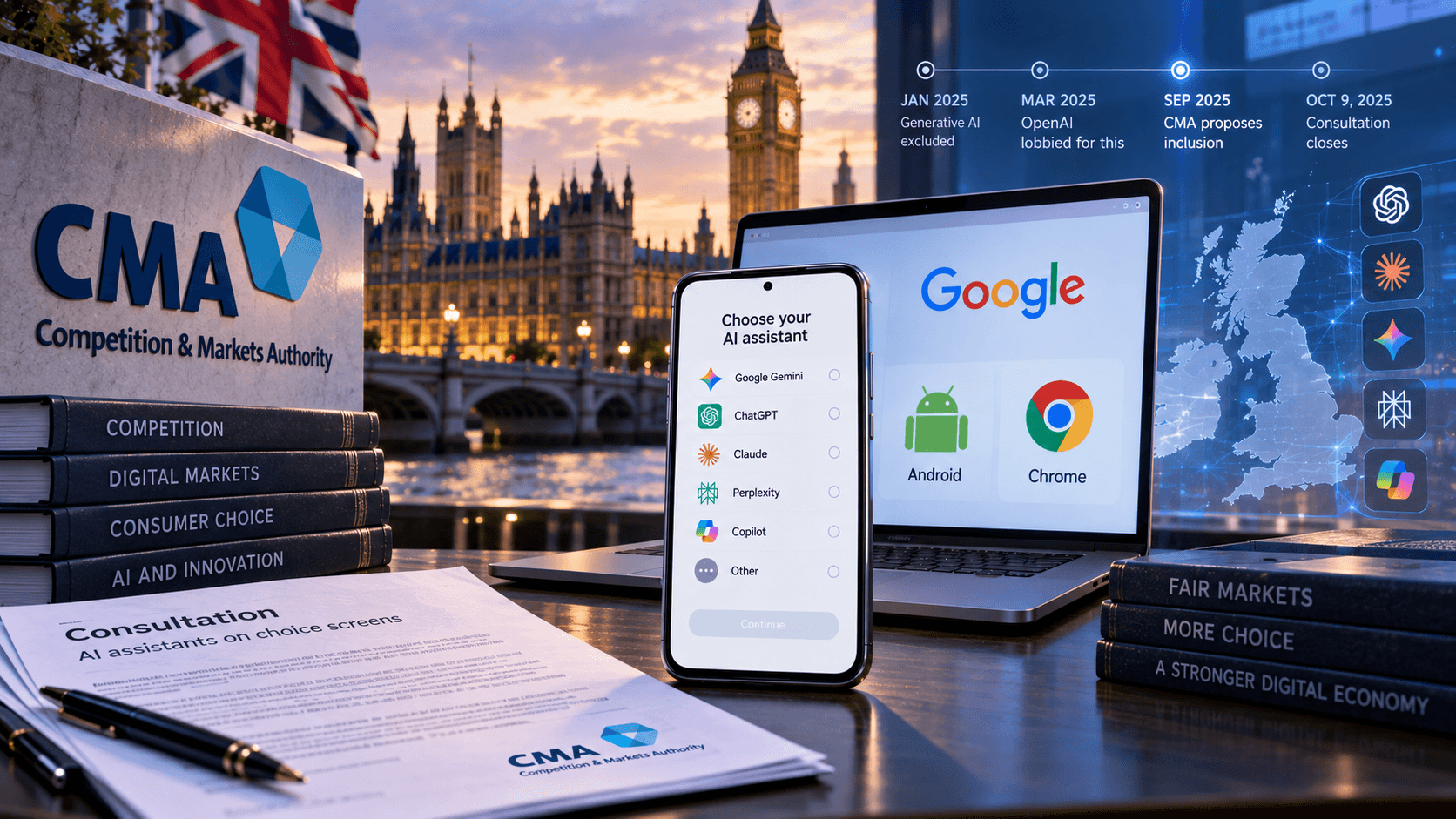
Key takeaways
- CMA proposes AI assistants join Google’s UK search choice screens on Android and Chrome.
- January’s draft excluded generative AI; consultation closes October 9, decision by end of 2026.
- OpenAI lobbied for the change in March; Google objected to the annual prompt, which stays.
Britain’s Competition and Markets Authority proposed on Wednesday, September 23, that Google must offer AI assistants alongside search engines on the choice screens it will have to show Android and Chrome users in the UK. Users would pick a default search service when they first set up a device or browser and be prompted again at least once a year.
The consultation runs to October 9, with a final decision expected by the end of 2026. It is the last piece of a package the regulator first put out in January, after giving Google “strategic market status” in search in October 2025.
What changed since January
In January the CMA’s draft rules left generative AI out. The consultation document noted that “no generative AI-based services are included in UK search choice screens”, and its eligibility test was written for search engines: a service had to address the full range of search use cases by searching the web and be regarded by a significant share of UK users as a general search service.
The new draft opens the door to AI assistants that meet technical and security criteria. The CMA’s chief executive, Sarah Cardell, put it this way: “We’ve listened carefully to feedback and are responding quickly to the rise of AI assistants, which people are increasingly using as their search service, but aren’t included on Google’s choice screens.” She called the change “future-proofing”.
There is a second new element. Search providers would have to attribute publishers’ content fairly, so that users can see where a result came from and reach the original source. For an assistant that answers in prose rather than a page of links, that is not a small condition.
Who asked for this
OpenAI did, in writing. Its March 6 submission to the January consultation urged the CMA to widen eligibility explicitly to “AI chatbots that include search functionality”, argued that ChatGPT is a competitive substitute for Google Search, and warned that criteria built on “traditional conceptions of search” would shut out new entrants. It also asked for the screen to appear the first time a user reaches Google search, and for Google to be given four months to implement rather than six. Reuters named ChatGPT and Perplexity as the kind of assistant that could qualify.
Google pushed the other way. The Next Web reported that in its March reply the company said presenting choice screens every year would annoy users, and proposed a permanent switch in device settings instead. The annual prompt survived.
Why a UK screen matters beyond the UK
What makes this round different from earlier choice screens is the category. Once a regulator defines an AI assistant as a search service for the purpose of defaults, the same logic is available to every other competition authority looking at Google, and to anyone arguing that the default assistant on a phone deserves the scrutiny the default search engine already gets.
So who gains? Assistant makers with UK users, provided they can pass whatever technical and security criteria the CMA settles on. Google, on which the CMA has already imposed publisher controls on June 3 and fair-ranking and data-portability requirements on June 17, loses a little more control over the first screen a UK user sees.
What is not yet decided
The press release does not spell out the criteria an assistant must meet, nor who judges them. Those details sit in the consultation document, and they will decide whether the screen features two assistants or ten. Reuters’ report carried no response from Google. Watch the October 9 deadline for the submissions, in particular whether OpenAI, Microsoft and Perplexity argue that the security bar should be low and whether Google argues it should be high.
- ChatGPT
- CMA
- UK regulation
- search
- AI business
Sources
- CMA strengthens proposals allowing people choice over their search service — GOV.UK (Competition and Markets Authority), Sep 23, 2026
- Consultation: User Choice Conduct Requirement — Competition and Markets Authority, Jan 28, 2026
- OpenAI response to the CMA consultation on proposed conduct requirements for Google search — OpenAI, via GOV.UK, Mar 6, 2026
- UK regulator toughens Google choice screen proposals as AI assistants rise — The Next Web, Sep 23, 2026
- Google faces UK push to put AI assistants on Android, Chrome choice screens — Reuters, via 93.3 The Drive, Sep 23, 2026
- Google’s general search and search advertising services — GOV.UK (Competition and Markets Authority)
Related stories

Microsoft pledges $10bn-plus for Gulf cloud and AI despite the war
Brad Smith says Microsoft is keeping every investment it planned before the conflict began on February 28 and adding to them: more than $10 billion across the UAE, Saudi Arabia, Qatar and Kuwait by 2030, plus $400 million for cables.
3 min read

Newsom signs seven data-centre laws on power costs, water and land
The bills signed on Monday create separate electricity tariffs for loads of 75 megawatts and more, require water-use disclosure before local approval, and pull data centres out of blanket environmental-review exemptions.
3 min read

45 US data centre projects worth $68bn blocked or delayed in Q2
Data Center Watch now counts 843 local opposition groups in 49 states. The dollar figure fell from the first quarter, yet more than half of newly tracked projects ran into trouble.
3 min read
Comments
No comments yet. Start the conversation.