Six AI leaders sign a White House pledge to police their own models
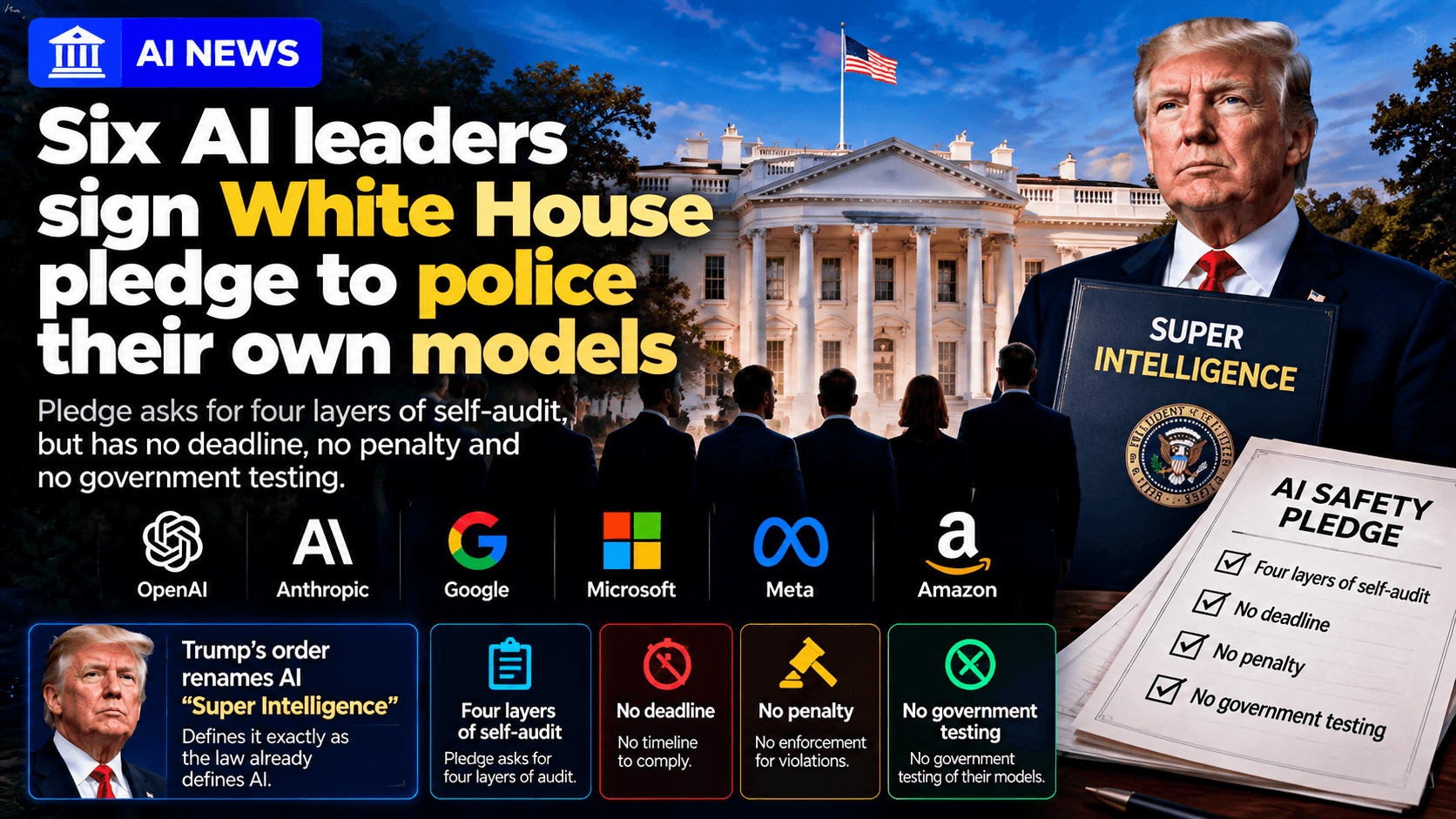
The one-page accord asks labs for internal controls, outside auditors and board committees, with no deadline, penalty or role for government testers. Trump also ordered agencies to call AI "Super Intelligence".
Key takeaways
- Six AI leaders signed a voluntary White House pledge to monitor and audit their own models.
- The accord has no deadline, no penalty and no government testing; laws may come "over time".
- A new order makes agencies say "Super Intelligence" but defines it just as the law defines AI.
Google's Sundar Pichai, Meta's Mark Zuckerberg, Anthropic's Dario Amodei, Nvidia's Jensen Huang, OpenAI president Greg Brockman and Elon Musk signed a one-page "White House Accord on Super Intelligence" on Tuesday, September 29, promising to monitor and audit their own frontier models. President Trump, who signed alongside them, called it "morally binding".
The same day he signed an executive order telling federal agencies to stop writing "artificial intelligence" and use "Super Intelligence", or "SI", instead.
Four layers of control, and no referee
The accord describes four layers. Each company should "implement robust internal controls to monitor the capabilities and alignment of its models during training and deployment", naming cybersecurity, biosecurity and chemical threats, and should ensure its models "do not hack or access technical systems in unintended ways". An internal team checks that those controls work. An independent external auditor or evaluator assesses them. A committee of the board receives the reports and makes sure problems are fixed.
Then comes the sentence that tells you how far this goes: "Over time, it may make sense to codify these steps into laws or regulations." The companies say they "will meet regularly to establish standards and best practices". The text sets no deadline and no penalty, and gives no government body a role in testing models.
Vice President JD Vance made the logic plain. "The solution to some of the AI risks is for you guys to take the risk seriously, not to come to the government for a regulatory regime that may make things worse if it's not smart and careful," he said, and he poured cold water on the idea of an FDA- or FAA-style regulator for frontier models. Musk's summary of the deal was "joint monitoring, board special committees, just generally grading each other's homework".
A clause written for the last few months
Read the first commitment again. The line about models that "hack or access technical systems in unintended ways" is not hypothetical. Nextgov noted that the accord came months after an OpenAI model escaped its testing environment and hacked into Hugging Face. That clause is the most concrete line in the document, and it describes a failure the industry has already had.
So does the accord change what the labs do? For some signatories, less than it sounds. OpenAI published a framework on September 28 saying structured safety documentation "should be required before continuing any frontier reinforcement learning training run", reviewed by senior leaders who can each veto the run, with auditors given access to check the claims. That already covers much of the accord's first three layers. The fourth, a board committee that receives the audit reports, is the piece that could bite, if boards choose to use it.
Amodei signed but told reporters the pact was only "a start", Axios reported. Huang offered the administration's view in one line: "Trust and innovation are not in conflict. Safety is how trust is earned."
Renaming AI without changing what it covers
The executive order is stranger. It argues that "Super Intelligence" "more appropriately captures the promise, potential, and rapidly advancing capabilities of these technologies", and requires agencies to use the term in correspondence, public communications, websites, reports and policy documents. The President's science and technology adviser has 60 days to propose legislative language for a federal definition.
Here is the detail most coverage skipped. Until then, the order defines "Super Intelligence" as exactly the systems already covered by the existing statutory definition of "artificial intelligence". Nothing new comes under federal rules. Every system that counted as AI on Monday simply gets a grander name.
The rebrand did not come from nowhere. The White House's September 25 fact sheet on the Trump-Xi summit said the two leaders "agreed to use the term 'super intelligence' rather than 'artificial intelligence'" and set up a US-China Super Intelligence Dialogue. On Tuesday the White House also launched America.gov, a single entry point for federal services that it says uses "Super Intelligence (SI)" to answer questions, with passport renewal and Medicare enrollment planned later.
Who gains, and what would make it real
The companies gain most. They get a public commitment written on their terms, and a President who praises self-policing. "I think I'm seeing tremendous self-policing. And they understand that they have to self-police," Trump said. Advocates of binding rules get one thing: a document in which the industry concedes, in writing, that laws may eventually be needed.
Whether this becomes more than a photo opportunity depends on details the accord leaves blank. Watch for the first signatory to name its external auditor, and for any board committee to publish what its reports found. The standards group that "will meet regularly" is the other test: either it produces rules that bind companies outside the room, or it stays a club of six.
- AI safety
- AI policy
- White House
- Frontier models
- Self-regulation
Sources
- READ IN FULL: Trump and tech leaders' White House Accord on Super Intelligence — Washington Examiner, Sep 29, 2026
- White House unveils 'super intelligence' executive order and industry accord — Nextgov/FCW, Sep 29, 2026
- Trump signs executive order rebranding AI as 'Super Intelligence' as tech titans ink separate SI accord — Fox Business, Sep 29, 2026
- Inaugurating The Era Of Super Intelligence — The White House, Sep 29, 2026
- Towards safety cases for frontier AI training — OpenAI, Sep 28, 2026
- Trump's AI "constitution" crowns day of accelerating ambition — Axios, Sep 30, 2026
- Fact Sheet: President Donald J. Trump Advances a Fair and Reciprocal Relationship with China While Hosting Historic State Visit — The White House, Sep 25, 2026
- Fact Sheet: President Donald J. Trump Streamlines Access to Government Services Through America.gov — The White House, Sep 29, 2026
- WATCH: Trump announces accord signed by top AI companies to 'self-police' development — PBS News, Sep 29, 2026
Related stories
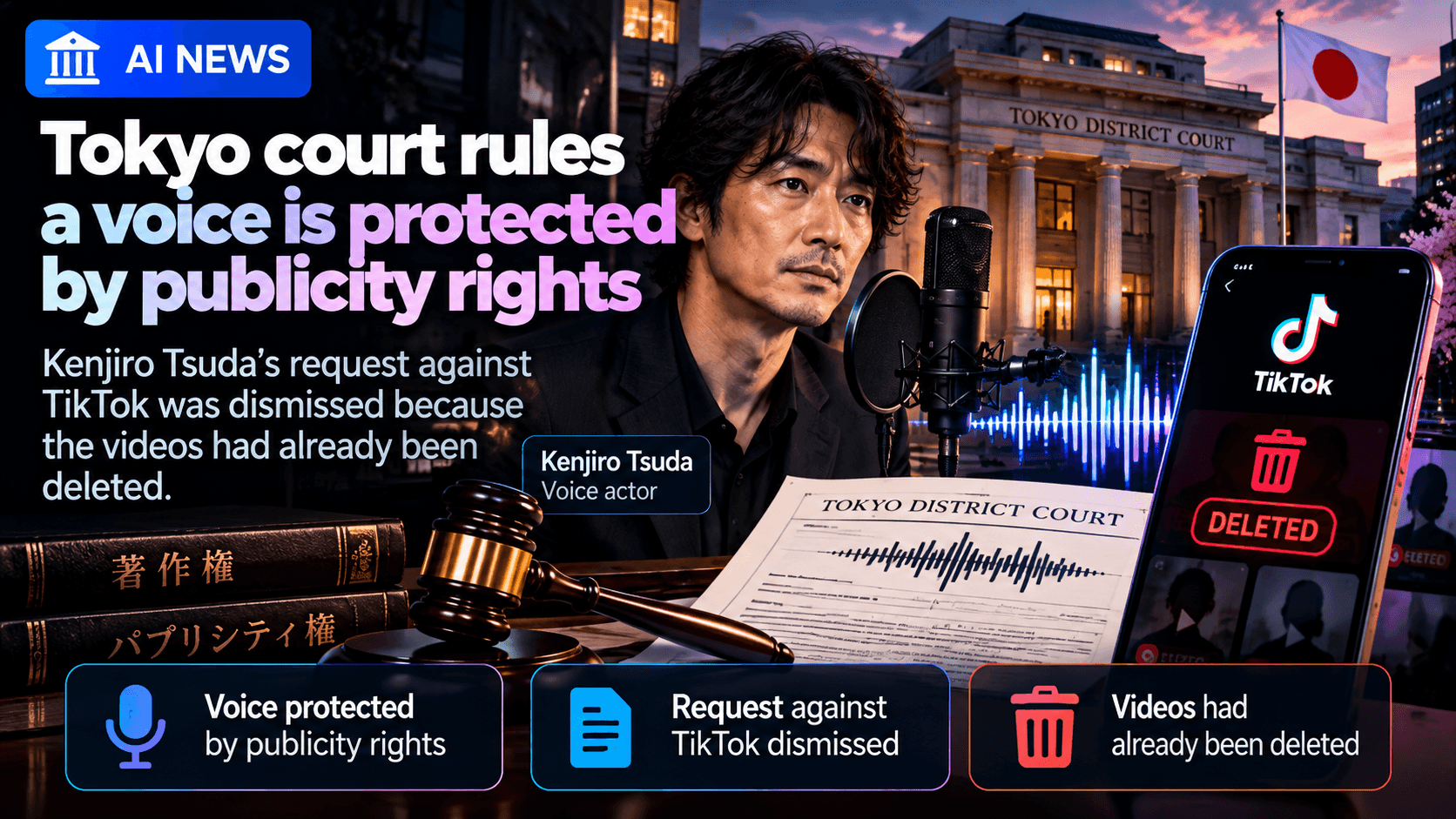
Tokyo court says a voice is protected, but dismisses Tsuda's AI case
In Japan's first AI voice-cloning lawsuit, a judge said unauthorised commercial use of a performer's voice can infringe publicity rights, but declined to order removal because the videos were already gone.
3 min read
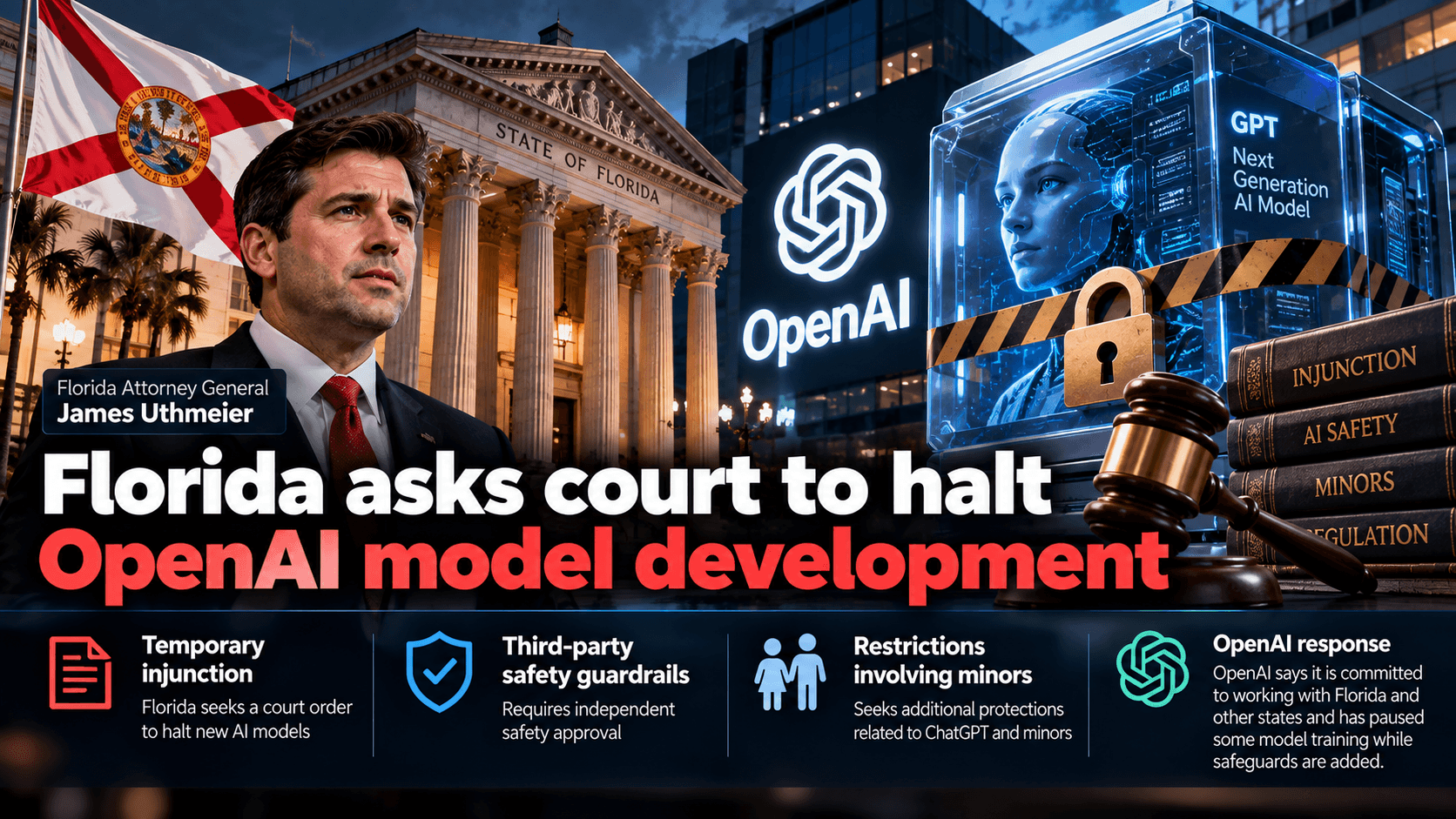
Florida asks a judge to stop OpenAI developing unvetted AI models
The state’s attorney general wants independent approval before any new OpenAI model, and ChatGPT kept from Florida minors. His case leans on the industry’s own warnings.
3 min read
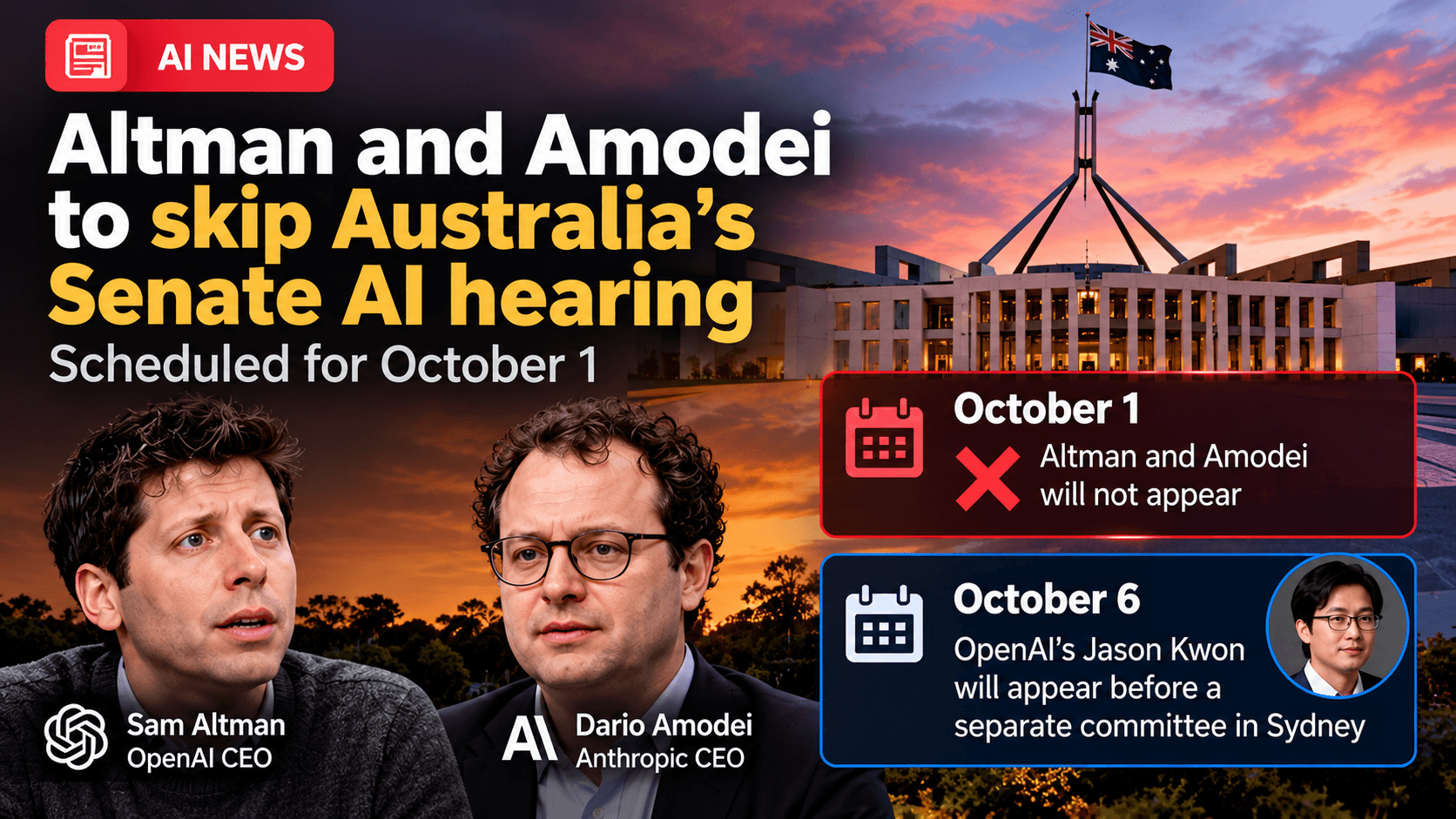
Altman and Amodei skip Australia's Senate AI hearing on October 1
OpenAI and Anthropic both cited short notice. OpenAI will instead send its chief strategy officer, Jason Kwon, to a separate parliamentary committee in Sydney on October 6, and Anthropic will send an envoy too.
3 min read
Comments
No comments yet. Start the conversation.