Qwen-Image-2.1 weights arrive under a research-only licence
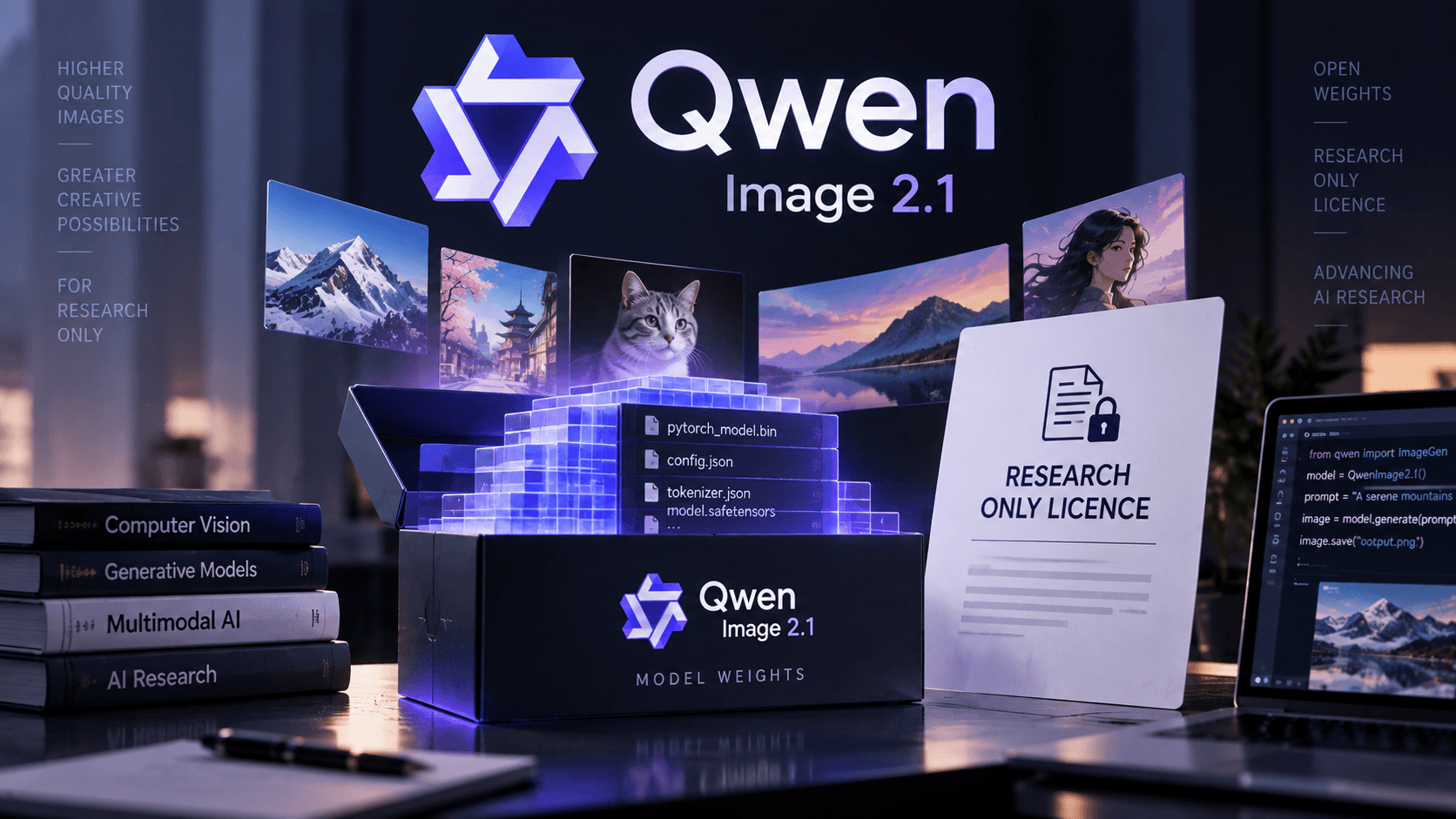
The new 7-billion-parameter image model generates and edits pictures with transparent backgrounds at 2K. You can download it, but you cannot build a business on it without asking.
Key takeaways
- Released Sept 20: a 7B-parameter generator with native 2K and transparent (RGBA) output.
- The licence is non-commercial; the 2025 Qwen-Image was released under Apache 2.0.
- No independent benchmarks yet, and no published terms or price for commercial use.
Alibaba's Qwen team released Qwen-Image-2.1 on September 20, putting the weights of its newest image generation and editing model on Hugging Face and ModelScope. Read the licence file before you get excited. The model comes under the Qwen Research License Agreement, which allows non-commercial use only.
That is a change of direction. The original Qwen-Image, released on August 4, 2025, is licensed under Apache 2.0, one of the most permissive licences in software, and businesses could build on it freely.
What the model does
Qwen describes 2.1 as "a unified text-to-image generation and image editing model". One set of weights handles both jobs. The part that draws the picture is a 7-billion-parameter diffusion transformer with 32 layers, paired with Qwen3-VL 8B as the text encoder. The original Qwen-Image had 20 billion parameters.
The feature designers will care about is transparency. The model can generate and edit RGBA images, meaning pictures with a transparent background, so there is no separate cut-out step. It accepts up to 10 reference images for an edit, and lets you mark the area to change with a circle, a painted annotation or a mask. It works natively at 2K resolution across seven aspect ratios, up to 2752×1536 pixels.
OrcaRouter also points to a companion download that got little attention: a prompt rewriter for editing, built on a fine-tuned Qwen3.5-VL 9B model of about 18.8 GB. It turns a loose instruction into a precise editing directive before the image model sees it.
Tooling arrived with it. Diffusers, ComfyUI, vLLM-Omni, SGLang and LightX2V all announced support on release day, and the repository lists AMD GPUs through ROCm alongside NVIDIA hardware.
Open weights, closed for business
The licence is short and plain: "You shall not use the Materials for any commercial purpose without obtaining a separate commercial license from us." Research and evaluation are allowed. Anything that earns money needs a request to Alibaba by email, and redistributed copies must carry a notice naming the licence and its copyright holder, Hangzhou Tongyi Laboratory Technology Co., Ltd.
So why does the GitHub page still call it Qwen's "most powerful open-source image generation model"? Because the phrase gets used loosely. You can download these weights and run them at home. You cannot put them inside a product. The usual meaning of open source includes the freedom to use the software commercially, and by that meaning this release does not qualify. "Open weights" is the accurate label.
Who gains and who loses
Researchers and hobbyists lose nothing. They get a smaller, newer model at no cost.
Startups that built image features on Qwen-Image under Apache 2.0 are the ones who need to read the fine print. They can keep using the older model, since its Apache licence still stands. Moving to 2.1 means negotiating, and the OrcaRouter blog, which examined the release, found no published terms for the commercial licence and no listed price for a hosted version.
That suggests Alibaba is starting to separate what it gives away from what it sells. OrcaRouter notes the company already offers a Qwen-Image 3.0 as a closed, hosted model. A free research model that advertises a paid one is a familiar pattern in software. It is a less generous one than the Apache release of 2025.
What has not been shown yet
There are no independent benchmarks. OrcaRouter says the only comparisons available so far come from Qwen's own material. The download is sizeable, about 33 GB across its three components by OrcaRouter's count, with the text encoder accounting for more than half. The model card suggests CPU offloading for GPUs short on memory.
Two things to watch. Will independent image-model leaderboards place 2.1 near the closed leaders? And will Alibaba publish commercial terms, or leave them to private negotiation?
- Qwen
- Alibaba
- Image generation
- Open weights
- Licensing
Sources
- GitHub - QwenLM/Qwen-Image-2.1: Qwen's most powerful open-source image generation model — Qwen (Alibaba) on GitHub, Sep 20, 2026
- Qwen/Qwen-Image-2.1 · Hugging Face — Qwen (Alibaba) on Hugging Face, Sep 20, 2026
- LICENSE · Qwen/Qwen-Image-2.1 at main — Qwen (Alibaba) on Hugging Face, Sep 20, 2026
- Qwen/Qwen-Image · Hugging Face — Qwen (Alibaba) on Hugging Face, Aug 4, 2025
- Qwen-Image 2.1 Shipped Quietly: Inside Qwen/Qwen-Image-2.1-PE-I2I — OrcaRouter, Sep 20, 2026
Comments
No comments yet. Start the conversation.