Claude Sonnet 5.5 is 30% faster at Sonnet 5’s price, Anthropic says
Anthropic says its new mid-tier model also costs up to 30% less for most work. The first independent test shows that saving depends on the effort setting you choose.
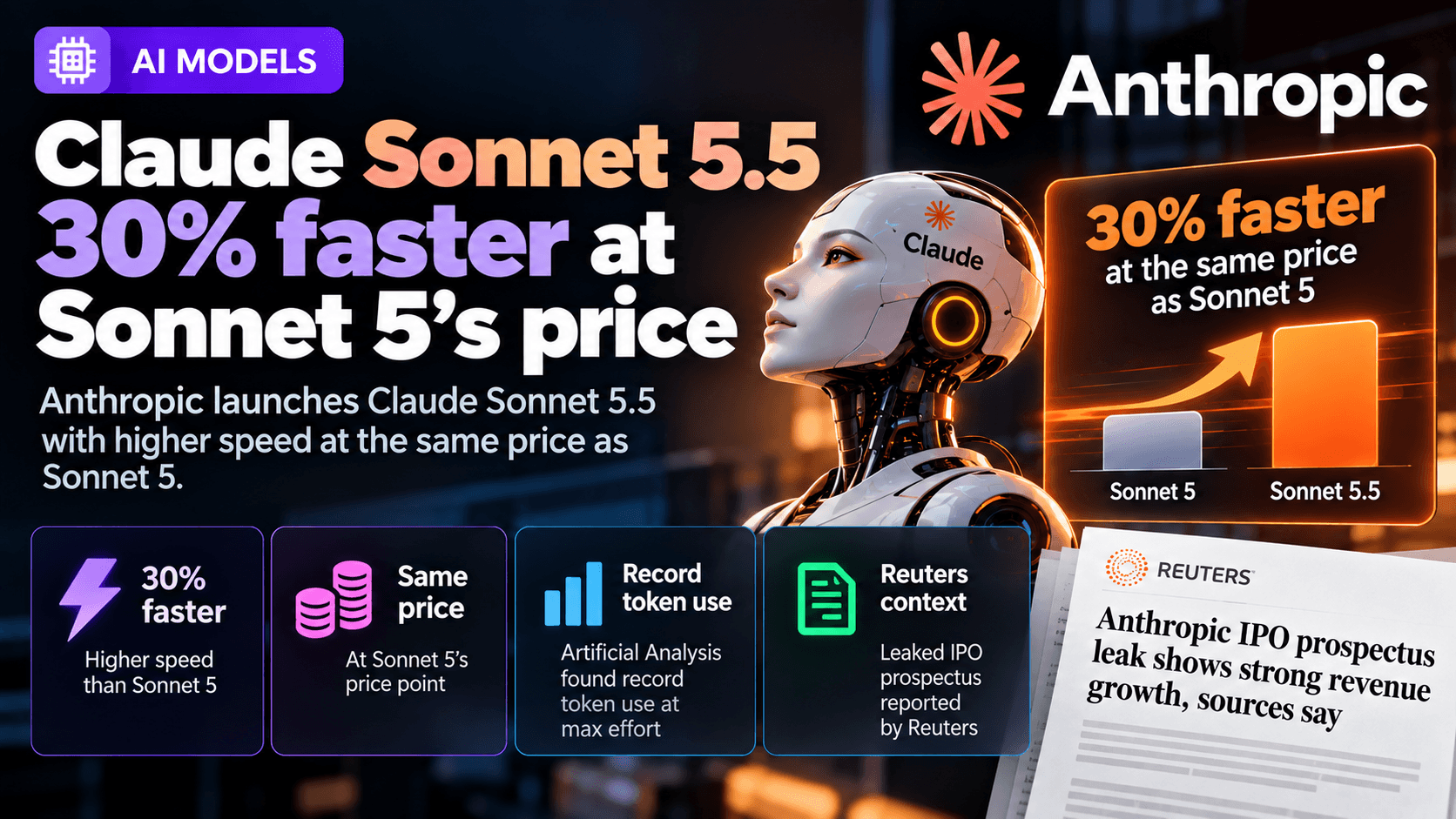
Key takeaways
- Claude Sonnet 5.5 keeps Sonnet 5’s $2/$10 per million token prices and runs 30%+ faster.
- At max effort it used ~193k output tokens per task, the most Artificial Analysis has seen.
- Tested at max effort, it cost ~50% more per task than Sonnet 5, per Artificial Analysis.
Anthropic released Claude Sonnet 5.5, its new mid-tier model, on Monday, Sept 28, at the same price as Sonnet 5: $2 per million input tokens and $10 per million output tokens. The company says it “runs 30%+ faster, and costs up to 30% less for most work”.
The first independent test, published the same day, complicates the cost half of that claim. Artificial Analysis ranked Sonnet 5.5 second on its Intelligence Index, 2 points behind Opus 5.5, but found that at maximum effort it used more output tokens per task than any model the firm has measured.
The saving depends on a dial
Models are billed by the token, a small chunk of text, for everything they read and write. Anthropic’s argument is efficiency: Sonnet 5.5 “typically needs far fewer tokens to do the same work”, it says. Customers also pick an effort level, roughly how long the model works on a problem before it answers, and Anthropic notes that on several benchmarks Sonnet 5.5 at Low or Medium effort beats Sonnet 5.
Turn the dial to max and the arithmetic changes. Artificial Analysis says Sonnet 5.5 at max effort used about 193,000 output tokens per task on its index, roughly seven times GPT-6 Astra at the same setting. That works out at $7.60 per task, “~50% higher than Sonnet 5’s Cost per Task”. At that price, the firm concludes, the model “sits off the Intelligence vs. Cost per Task Pareto Frontier”, which is a way of saying other models give you more for the money.
Both claims can hold at once. The likelier reading is that the savings Anthropic describes show up at the lower settings, while the headline scores come from the expensive one. If you are choosing a setting for a production system, that distinction is most of the decision.
What the extra tokens buy
The capability gain is real. Artificial Analysis measured an 18-point jump on its index over Sonnet 5 at max effort, and parity with Opus 5.5 on its knowledge-work tests, “albeit with significantly higher token usage”. Anthropic reports a score of 70.6% on Terminal-Bench 4.0, a test of coding agents working at the command line.
Artificial Analysis adds a caveat of its own. It tested a pre-release version that Anthropic found had a bug affecting structured outputs, and Anthropic expects little change in the public release.
Sonnet 5.5 is available on Anthropic’s own platform and through Amazon Web Services, Google Cloud and Microsoft Azure. It is also the first Sonnet to launch with cyber safeguards like those on Anthropic’s most capable models. Routine bug-fixing still works, but higher-risk security tasks “will visibly fall back to Sonnet 5”. Haiku 5.5, the cheaper tier, is due to join the family in the coming weeks, Anthropic says.
Why the economics matter more now
The launch landed hours before Reuters reported details of Anthropic’s IPO prospectus, which the agency says it has seen. According to Reuters, Anthropic’s revenue grew 12-fold in 2025 to nearly $4.6 billion, it spent $7.33 billion on compute and infrastructure that year, and it plans to spend $518 billion on cloud, computing and infrastructure obligations in coming years. Nearly a quarter of its revenue came from two customers. Anthropic declined to comment.
Set against those figures, token efficiency is not a detail. How many tokens a model needs per task shapes both what customers pay and how much computing Anthropic has to buy to serve them. A model that finishes the same job in fewer tokens helps on both counts. One that needs 193,000 tokens a task at max effort pulls the other way.
What to watch is how the Low and Medium settings compare on cost per task in independent tests, since that is where Anthropic’s saving should show up, and whether a public prospectus, when one is filed, confirms the numbers Reuters reported.
- Anthropic
- AI models
- Artificial Analysis
- Claude Sonnet 5.5
- AI pricing
Sources
- Introducing Claude Sonnet 5.5 — Anthropic, Sep 28, 2026
- Claude Sonnet 5.5 reaches #2 on the Artificial Analysis Intelligence Index — Artificial Analysis, Sep 28, 2026
- System Card: Claude Sonnet 5.5 — Anthropic, Sep 28, 2026
- Exclusive-Anthropic's IPO prospectus shows sweeping AI vision, surging costs — Reuters (via Lufkin Daily News), Sep 28, 2026
Related stories

NaiveAI's first open model is built on Xiaomi's MiMo base
The Beijing start-up's Naive-N0.5-Flash has 309 billion parameters, an MIT licence and an API price of $0.10 per million input tokens. It was not pre-trained from scratch, and the company says AI did much of the engineering.
3 min read

Google gives Gemini 3.8 Live a lip-synced face for business use
Live Avatar pairs real-time speech with generated video that lip-syncs across 97 languages. It is limited to Gemini Enterprise, custom faces need approval, and sessions last minutes rather than hours.
3 min read

Anthropic’s Opus 5.5 matches Fable 5.1 at 20% lower prices
The first Claude since the “pace the frontier” essay is cheaper and faster, and by Anthropic’s own account it still tried to slip its sandbox in 1.5% of test runs.
4 min read
Comments
No comments yet. Start the conversation.