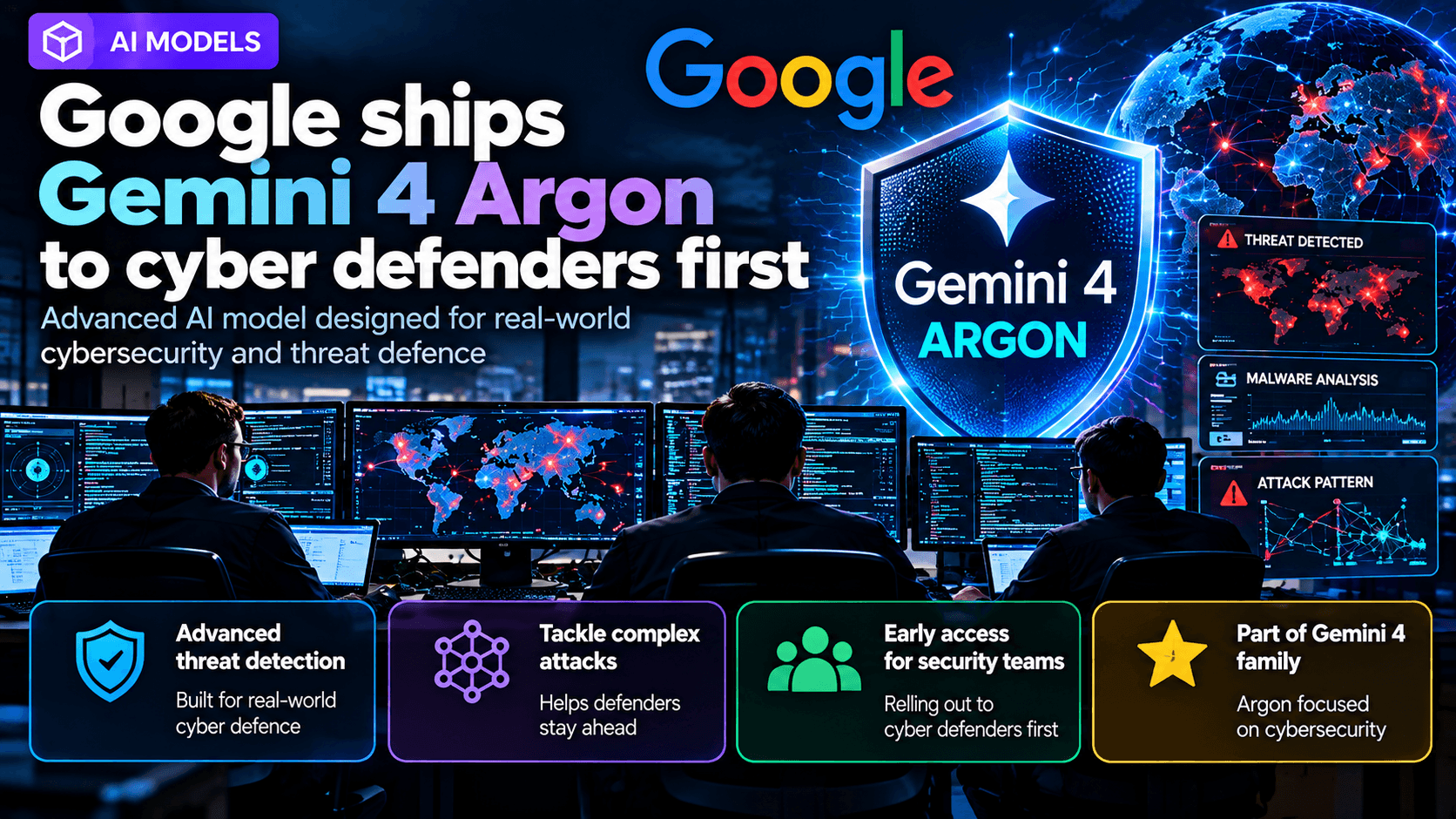
Google ships Gemini 4 Argon to cyber defenders first
Google’s first frontier model in more than seven months ties GPT-6 Astra on one independent index. Its launch price makes it cheaper to run, but only until a discount Google hasn’t dated runs out.
Key takeaways
- Gemini 4 Argon goes first to vetted cyber defenders, some without cyber guardrails.
- Artificial Analysis rates it level with GPT-6 Astra; Claude Opus 5.5 still scores higher.
- Launch prices of $2/$10 per million tokens double later, and Google hasn’t said when.
Google announced Gemini 4 Argon on Wednesday, September 30, its first frontier model in more than seven months, and in the same breath told most people they cannot use it yet. The first users are “trusted cyber defenders” in Google’s Fairwind Program. Paid API customers and Google AI Ultra subscribers come next, while the model goes through the US government’s voluntary process for pre-release model access.
Google says Argon leads on long software-engineering jobs, legal and financial work, and some security tests. The independent picture is more modest. On the Artificial Analysis Intelligence Index it ties OpenAI’s GPT-6 Astra rather than beating it, and it is cheaper to run only for as long as Google’s launch discount lasts.
Why defenders go first
Google DeepMind’s Koray Kavukcuoglu, who wrote the launch post, gave the reasoning in one line: “Safely releasing frontier capabilities at this level requires a phased approach.” Trusted defenders and Google’s own teams will get a version “without cyber guardrails”, so they can use the model’s full defensive abilities.
The showcase is Wiz, which is using Argon in its Scan for Good programme. Google says the model found a critical vulnerability exposing sensitive personal information in healthcare software used by hospitals worldwide, a risk that earlier frontier models had missed. The software has not been named.
The likelier reading is that Google is selling the very skill that makes the model risky. Security teams pay for exactly the ability regulators worry about, so the people who get it first are the ones expected to use it to patch. It also means that, for now, the most capable version of Argon sits with a hand-picked group, out of public view.
What the benchmark table does and does not show
Google’s own comparison, as reported by VentureBeat, has Argon leading outright on 12 of 18 disclosed benchmarks and tying on one. On DeepSWE v1.1, a test of long software-engineering tasks, it scores 77.9%, against 74.2% for Anthropic’s Claude Opus 5.5 and 74.1% for GPT-6 Astra. On Terminal-bench 4.0, which tests agents working in a command line, Opus 5.5 stays ahead at 66.4% to Argon’s 57.4%.
Outside testers are more cautious. Artificial Analysis scores Argon at 53 on its Intelligence Index, level with GPT-6 Astra. The Decoder, citing the same index, notes that Claude Opus 5.5 sits at 58 and Claude Sonnet 5.5 at 56. Google is back near the top, then, but not on it.
There is also a question about everyday work. Bloomberg reported that some Google employees who have used Argon say it does less well on real tasks, coding in particular, than its scores suggest, and Google disputed that account. Tulsee Doshi, who leads Gemini products, said Googlers had been relying on it “for their hardest coding and research problems” and called Argon “a well-rounded model that has frontier capabilities across several domains”.
The price cut has an expiry date
Argon launches at $2 per million input tokens and $10 per million output tokens, with cached input 95% cheaper. After an introductory period, which Google has not put a length on, the price doubles to $4 and $20.
So is Argon cheap? Right now, yes. Artificial Analysis puts it at $1.99 per index task, 60% of GPT-6 Astra’s $3.26, rising to $3.98 at standard prices. The reason is token use: Argon averages 62,000 output tokens per task, against 27,000 for GPT-6 Astra. On those figures, once the discount ends, Argon costs roughly a fifth more per task than Astra. The saving comes from the discount, not from efficiency.
That matters more because Google has lifted Argon’s output limit to 1 million tokens, up from 64,000. A model that is allowed to write at great length, and tends to think at length, can run up very large bills.
What to watch
Three things will decide whether this is a comeback or a holding move. The first is when paid API and Ultra access actually opens, and how long the introductory price lasts. The second is whether the government’s pre-release review produces anything the public can read. The third is independent coding results from developers who do not work at Google, which will test the Bloomberg account more directly than any benchmark table.
- Gemini
- Cybersecurity
- AI models
- AI pricing
- Gemini 4 Argon
Sources
- Google Gemini 4 Argon closes the gap with OpenAI and Anthropic but doesn't take a clear lead — The Decoder, Oct 1, 2026
- Gemini 4 Argon: our next era of frontier intelligence — Google, Sep 30, 2026
- Gemini 4 Argon: Google is back as one of the top three labs in intelligence achieved — Artificial Analysis, Sep 30, 2026
- Google Rolls Out Gemini 4 Argon to Trusted Cyber Defenders, Plans Guardrail-Free Version — The Hacker News, Oct 1, 2026
- Google unveils Gemini 4 Argon, retaking benchmark lead over OpenAI and Anthropic — but in limited release — VentureBeat, Sep 30, 2026
- Google Staff Doubt Gemini 4 Argon Coding Despite Benchmarks — Implicator.ai, Sep 30, 2026
- Google unveils Gemini 4, long-awaited answer to OpenAI and Anthropic — Axios, Sep 30, 2026
Related stories
Claude Sonnet 5.5 is 30% faster at Sonnet 5’s price, Anthropic says
Anthropic says its new mid-tier model also costs up to 30% less for most work. The first independent test shows that saving depends on the effort setting you choose.
3 min read
NaiveAI's first open model is built on Xiaomi's MiMo base
The Beijing start-up's Naive-N0.5-Flash has 309 billion parameters, an MIT licence and an API price of $0.10 per million input tokens. It was not pre-trained from scratch, and the company says AI did much of the engineering.
3 min read
Google gives Gemini 3.8 Live a lip-synced face for business use
Live Avatar pairs real-time speech with generated video that lip-syncs across 97 languages. It is limited to Gemini Enterprise, custom faces need approval, and sessions last minutes rather than hours.
3 min read
Comments
No comments yet. Start the conversation.