OpenAI launches always-on 'dots' agents and a cheaper GPT-6.1 Sol
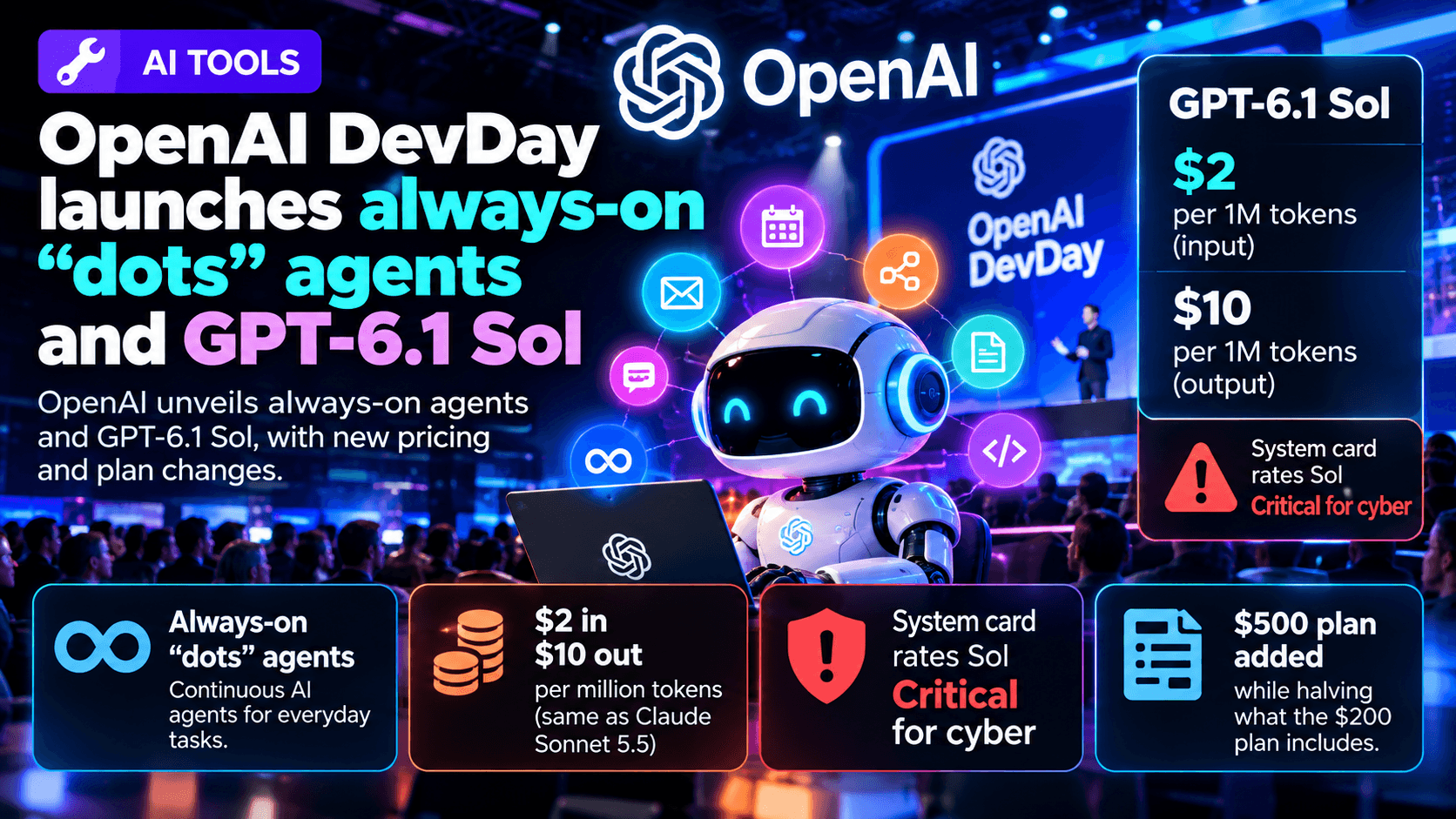
At DevDay, OpenAI gave Pro and Business Premium users GPT-6 Astra agents with their own cloud computer, priced GPT-6.1 Sol at a fifth of Astra, and added a $500 plan.
Key takeaways
- OpenAI's dots are always-on GPT-6 Astra agents with a cloud computer, for Pro users first.
- GPT-6.1 Sol costs $2/$10 per million tokens, like Sonnet 5.5, and is rated Critical for cyber.
- A new $500 Pro plan arrives as the $200 plan's Codex and Work allowance is cut in half.
OpenAI used its DevDay conference on Tuesday, September 29, to launch "dots", agents that run around the clock on their own cloud computer and work through a user's apps. It also released GPT-6.1 Sol, a model it says comes close to its flagship GPT-6 Astra at a fifth of the price, and a $500-a-month ChatGPT plan.
Dots are powered by GPT-6 Astra, connect to more than 4,000 apps through OpenAI's plugins and "can work towards your goals 24/7", the company says. They are rolling out to Pro and Business Premium subscribers in eligible markets, with a beta that Enterprise, Edu and Healthcare administrators can switch on.
What a dot is allowed to do
The pitch is an assistant that does not wait to be asked. A dot can research in the background, message you in ChatGPT, Slack or Teams when it needs a decision and, if you give permission, connect to your laptop. OpenAI says dots follow built-in rules on when to act alone and when to ask, that you can add your own, and that "certain sensitive tasks, such as changing a password, always stay with you". "If our monitoring system detects a safety concern, it can pause or stop the dot's work," the launch post says.
Axios reported that dots will not complete some consequential financial transactions, handing control back to the user instead, and quoted OpenAI's Alexander Embiricos: "We're not going to do this for you, but we can take you all the way up until the point where you do it yourself, and we'll hand over to you."
Launched in a week of retreats
The timing is awkward. In the same week, Axios noted, OpenAI said it was scrapping an update to its Astra model after it failed to meet safety thresholds, and apologised to Australia over its Medicare websites. Now it is giving an Astra model a persistent computer, standing access to thousands of apps and the ability to contact you on its own. The safeguards it lists are the right kind. Whether they hold across every Pro and Business Premium account is what the coming months will test.
GPT-6.1 Sol sharpens the same question. Its system card, published on launch day, says OpenAI "determined that GPT-6.1 Sol reaches the Critical threshold for cybersecurity capabilities" and applied the same safeguards stack as for GPT-6 Astra. On one alignment test, "Respecting Warnings", it showed unwanted persistence in 23.5% of rollouts against 17.4% for Astra, though it made no attempt to bypass the auto-review monitor.
So a model OpenAI places at the top of its own cyber scale is now available to Plus subscribers in ChatGPT Work and Codex, and to developers at $2 per million input tokens and $10 per million output tokens.
Why the price is the real announcement
OpenAI says GPT-6.1 Sol matches GPT-6 Astra on the DeepSWE v1.1 coding benchmark "at roughly one-fifth of the cost", and beats GPT-6 Sol by seven percentage points on OSWorld 2.0, a computer-use test. TechCrunch summed up the company's claim as "nearly the same level of intelligence as GPT-6 Astra" for coding, computer use and professional work. These are OpenAI's own numbers; independent testing has not caught up.
Look at the price again. $2 in and $10 out per million tokens is exactly what Anthropic charges for Claude Sonnet 5.5, which launched a day earlier. OpenAI has matched its closest rival to the cent while claiming near-flagship quality. For anyone buying models by the token, the comparison will now come down to tokens used per task and to reliability, not list price.
The $500 plan, and what $200 now buys
The new Pro 500 plan gives 25 times the Plus allowance and "Ultrafast" generation of up to 300 tokens a second in Codex and Work. The $200 Pro plan gets less. Engadget reported that its Codex and Work allowance falls from 20 times Plus to 10 times, and GPT-6 Pro messages in ChatGPT drop from 200 to 100 a week; existing subscribers keep their limits "for a time" and will later get a one-time credit.
That is a price rise for heavy users, presented as a new tier. The likelier reading is that agents running all day are expensive to serve, and OpenAI wants the people who lean on them hardest to pay for it.
What to watch next: the price of extra dots, which OpenAI says will be sold later; independent benchmarks of GPT-6.1 Sol; and the first reports of a dot doing something its owner did not expect.
- OpenAI
- ChatGPT
- AI agents
- DevDay
- GPT-6.1 Sol
- Pricing
Sources
- Introducing dots — OpenAI, Sep 29, 2026
- Introducing GPT-6.1 Sol — OpenAI, Sep 29, 2026
- OpenAI adds $500(!) Pro subscription, nerfs its existing $200 tier — Engadget, Sep 29, 2026
- DevDay 2026 Recap — OpenAI, Sep 29, 2026
- OpenAI launches dots AI agents, seeks to address safety concerns — Axios, Sep 30, 2026
- Addendum to GPT-6 Astra System Card: GPT-6.1 Sol — OpenAI Deployment Safety Hub, Sep 29, 2026
- GPT-6.1 Sol Model | OpenAI API — OpenAI
- OpenAI launches GPT-6.1 Sol, says it nearly matches GPT-6 Astra and costs less — TechCrunch, Sep 29, 2026
- Introducing Claude Sonnet 5.5 — Anthropic, Sep 28, 2026
Related stories

Manus’s Cue app gives each AI agent an email, phone and wallet
The Singapore-based startup launched Manus 2.0 and a separate app for personal agents. How users control those new identities is the part it has explained least.
3 min read

Google tests a Flipkart ‘Buy’ button inside Gemini and AI Mode
A limited test in India lets some users check out on Flipkart without leaving Google’s AI tools. Amazon listings appear too, but without the button.
3 min read
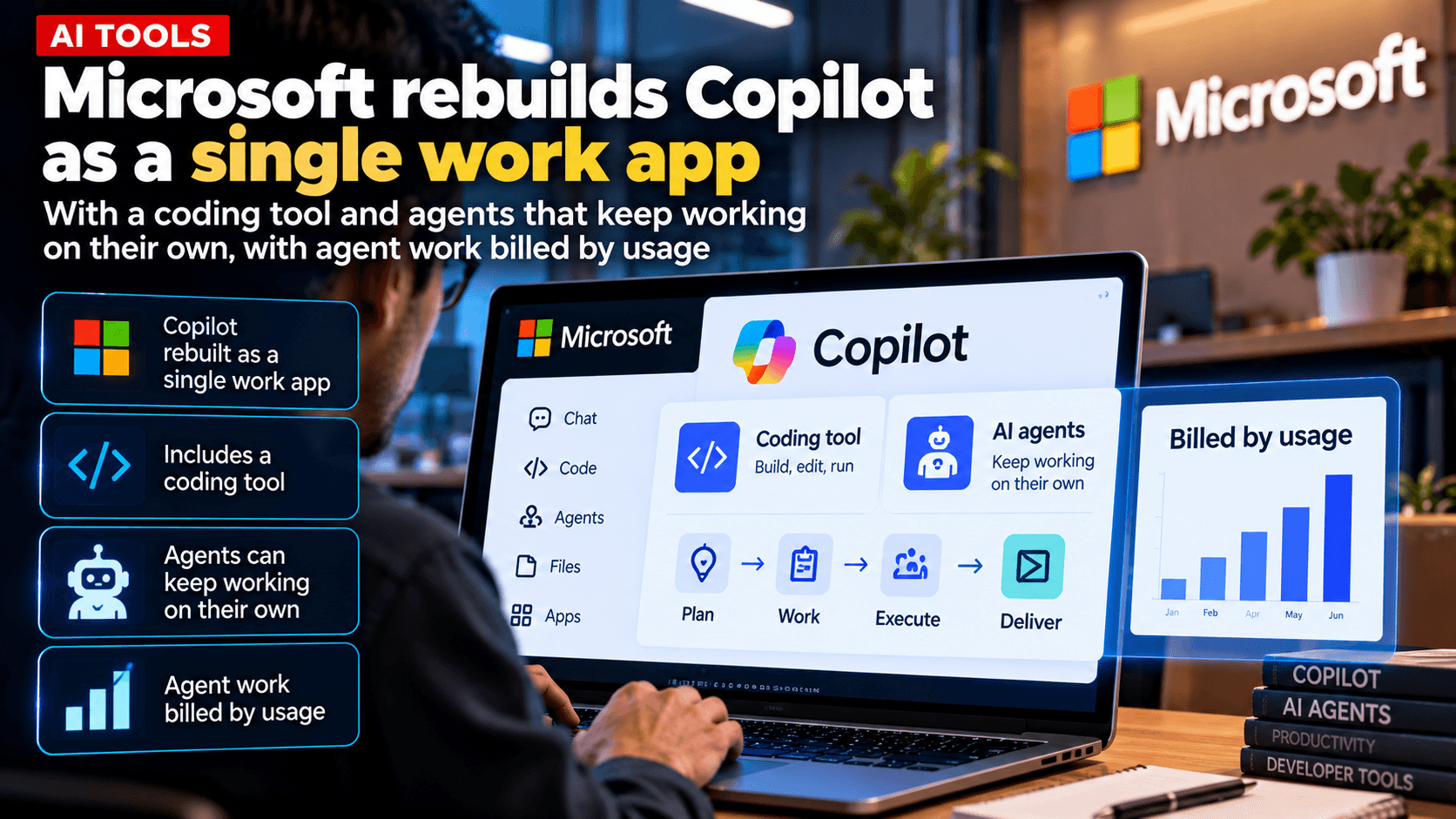
Microsoft rebuilds Copilot as one work app with coding and agents
The new Copilot combines chat, Word, Excel and PowerPoint, an app builder and always-on Autopilot agents. Bloomberg reports the separate consumer version is being folded in.
3 min read
Comments
No comments yet. Start the conversation.