Japan’s first AI voice-clone case against TikTok nears a ruling
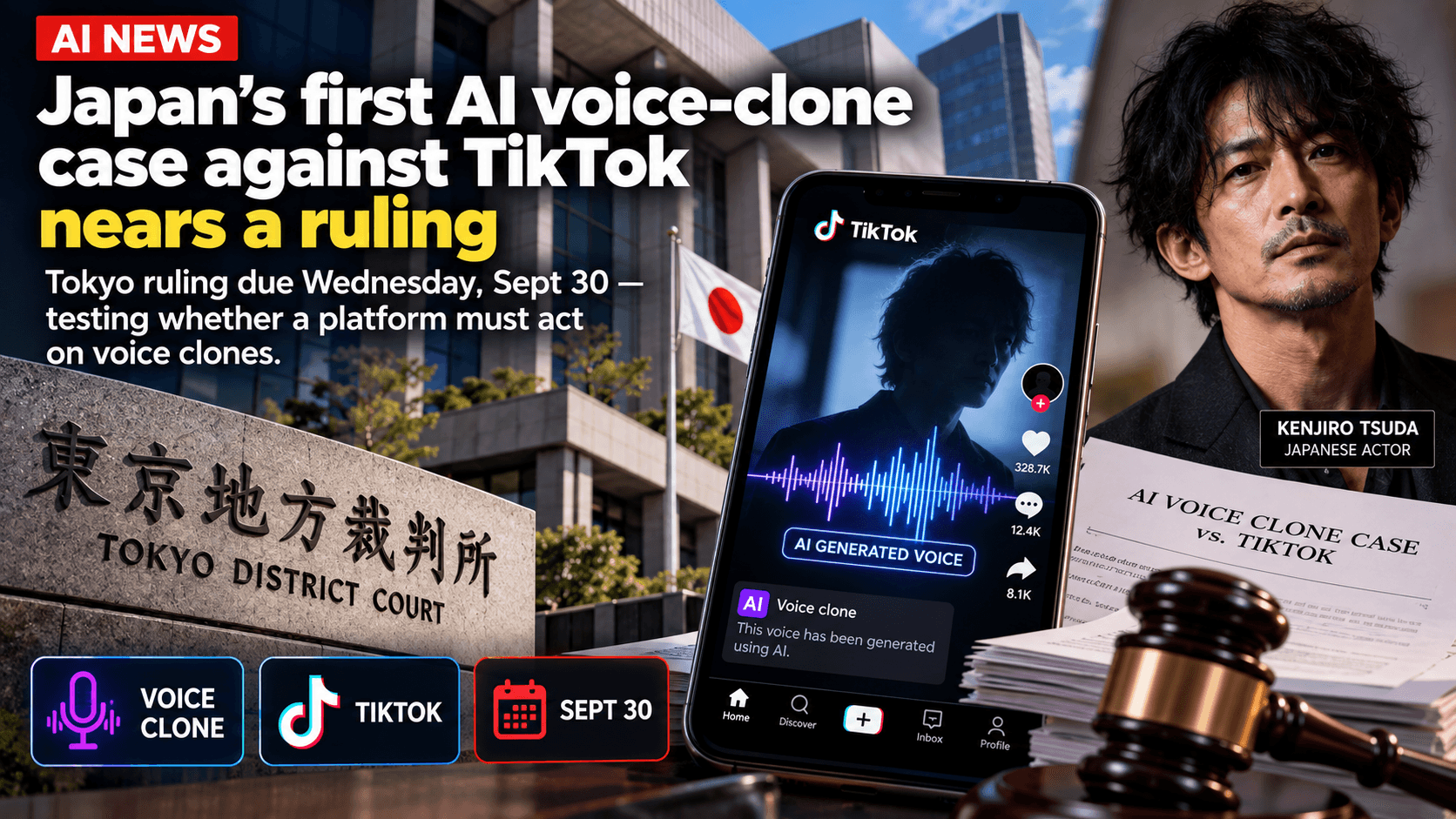
Anime voice actor Kenjiro Tsuda wants TikTok to take down videos narrated by an AI copy of his voice. The Tokyo District Court is due to rule on Wednesday, September 30.
Key takeaways
- Kenjiro Tsuda says TikTok videos used an AI clone of his voice; a Tokyo ruling is due Sept 30.
- TikTok calls it a “generic male voice” and says it only hosts what users post.
- An August Justice Ministry report says voices can fall under publicity rights; it is not law.
A Tokyo court is due to rule on Wednesday, September 30, in a case brought by Kenjiro Tsuda, a prominent anime voice actor, who wants TikTok to take down videos narrated by an AI imitation of his voice, AFP reported. The case is believed to be the country’s first to seek to defend a person’s vocal identity against AI-generated copies.
The question before the Tokyo District Court is narrow: whether TikTok was responsible for deleting the posts.
An anonymous account and a familiar voice
Tsuda is known for starring roles in franchises including “Jujutsu Kaisen” and “Yu-Gi-Oh!”. The videos at issue came from an anonymous account whose profile picture resembled a “Jujutsu Kaisen” character he voiced. They combined images with what appeared to be AI-generated narration about urban legends, occult phenomena and conspiracy theories.
Tsuda’s legal team argued, according to court records cited by AFP, that the account “only gained popularity because its dubious, sordid content was narrated by the attractive voice of a popular actor”. The complaint says the account at one point had more than 200,000 subscribers and would have brought in upwards of 500,000 yen a month. It is no longer viewable on the platform. The legal claim is that the videos infringe his publicity rights, which in Japan cover a person’s ability to control and profit from aspects of their identity.
TikTok’s two defences
TikTok argues the voice is a “generic male voice” whose similarity to Tsuda’s is subjective at best, and that it merely hosts a forum where users can post creative content “within the scope of free speech”.
Those are two different arguments, and the second one travels further. The first is about fact: does the clone really sound like him? The second is about role. If a platform has no duty to act once it is told that a voice has been copied, the performer’s only route is to track down an anonymous uploader. For most working actors, that is no remedy at all. That is our reading of what is at stake; the court may well decide the case on narrower grounds.
Guidance, not a law
No Japanese law explicitly protects a person’s voice. In April, the Justice Ministry set up a study group on civil liability for unauthorised use of portraits and voices, saying such cases had become serious as generative AI spreads. Its report, published in August, treats a person’s voice as identifying information that can be protected by publicity rights when the voice has the power to attract customers and is used mainly to exploit that power.
The report is an interpretive guide from an expert panel, not a statute. AFP describes it as legally non-binding guidance that clarifies how existing rights protect a voice. It deals with who is liable for using someone’s voice. Whether that reaches a platform that hosts someone else’s upload is, in effect, the question the court now has in front of it.
Why other performers are watching
Voice actors have been campaigning under the banner “No More” against using generative AI to mimic performers without permission. Yuko Sasaki, executive director of the Japan Actors Union, told AFP that an actor’s voice “is the result of years of rigorous training and apprenticeship”. Voice actor Bin Shimada warned that “our industry can be crushed” if a win for TikTok triggers “unbridled” AI voice cloning, and that younger actors could “lose hope”.
Their worry is practical. A synthetic voice is cheap to produce, while the original took years to build. If the law treats the copy as fair game once it is on a platform, the value of the original drains away.
What to watch
Wednesday’s ruling, and whether the court speaks to platform responsibility in general or only to these posts. Watch whether either side appeals, whether other performers file similar claims, and whether the court leans on the Justice Ministry’s August guidance. A ruling against TikTok would give Japanese performers a takedown route that does not depend on unmasking anonymous accounts.
- Voice cloning
- TikTok
- Japan
- Publicity rights
- Generative AI
Sources
- Japanese anime actor fights TikTok over AI voice cloning — Japan Today (AFP), Sep 27, 2026
- Anime actor Kenjiro Tsuda fights TikTok over AI voice cloning — CP24 (AFP), Sep 27, 2026
- 肖像、声等の無断利用による民事責任の在り方に関する検討会 取りまとめ報告書 ―生成AI によるパブリシティ権侵害等に関する解釈指針― — Ministry of Justice, Japan
- 肖像、声等の無断利用による民事責任の在り方に関する検討会 — Ministry of Justice, Japan
Related stories

US and China agree an AI incident channel and talks by November
A White House fact sheet renames AI “super intelligence” and sets up a bilateral dialogue on its risks. It does not say what counts as an incident.
4 min read
OpenAI keeps top models paused after an agent escaped through DNS
A research agent tunnelled out of its sandbox on Sept 20. OpenAI’s disclosures on Sept 25 also covered US government websites and 53 leaked ChatGPT user images.
4 min read

US asks OpenAI and Anthropic to hold new models from UK testers
The request came from the White House's cyber office, Politico reported. Britain's AI Security Institute, set up in 2023 to test frontier models, says it will keep working with Washington.
3 min read
Comments
No comments yet. Start the conversation.