Cognition says Devin passed a $1bn annual revenue run rate
The coding-agent maker roughly doubled its run rate in about four months. A run rate is a snapshot rather than a year of sales, and the market around Devin is getting cheaper and more crowded.
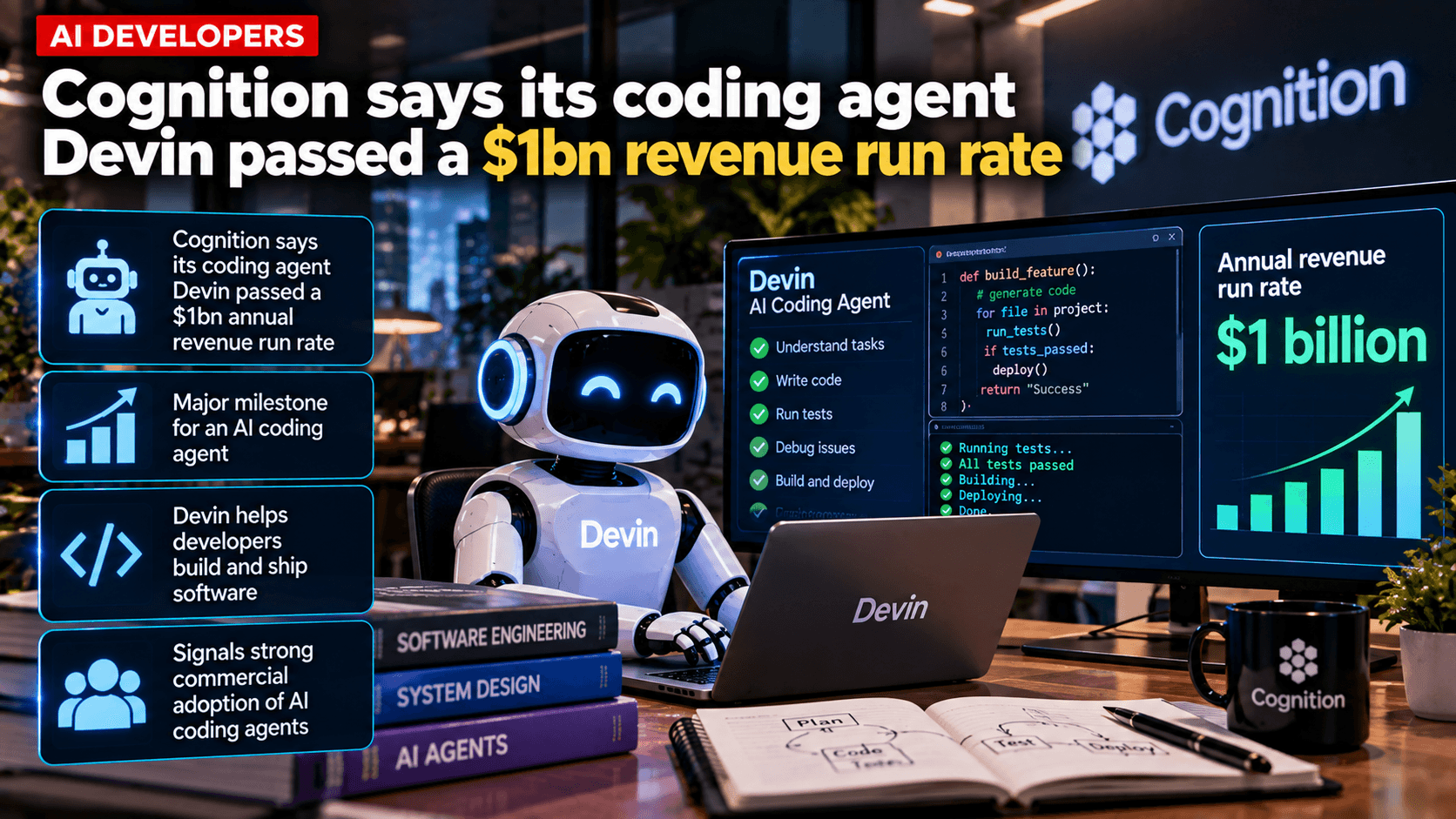
Key takeaways
- Cognition says it crossed a $1bn annualised revenue run rate on Sept 25.
- Its run rate was $492m in May and almost $900m by Sept 8, when it raised $2bn+ at $48bn.
- Cognition has not disclosed profit or margins; model prices fell sharply the same week.
Cognition, the company behind the AI software engineer Devin, says it has crossed $1 billion in annualised revenue run rate. It announced the figure on September 25, less than two years after Devin became generally available. The company itself was founded in January 2024.
The pace is the story. Cognition’s run rate was $492 million at its previous funding round in May and “almost $900M” by September 8, when it announced it had raised more than $2 billion at a $48 billion valuation. The valuation moved just as fast: Bloomberg notes the $48 billion figure nearly doubled the $26 billion set about three months earlier.
What a run rate tells you, and what it does not
A run rate takes recent revenue and scales it up to a full year. It measures momentum. It is not a year of booked sales, and Cognition has not published profit, margins or how much of its revenue comes from fixed contracts rather than usage. Bloomberg, which reported the milestone, says sales roughly doubled in about four months.
That caveat matters for coding agents in particular. Where customers pay for how much work an agent does, a busy month lifts the annualised figure and a quiet one pulls it down.
Who is paying for Devin
Cognition names GE Aerospace, Rivian, Rohlik and Exa among the teams using Devin. Its September funding post added engineering teams at Nvidia, Citi, Mercedes-Benz and Modal. The run-rate post gives them the credit: “This milestone belongs to them.” What it does not give is a count of paying customers or how much the largest ones spend, which would show whether growth is broad or rests on a few big accounts. The pitch is in the first lines of its announcement: “the world needs far more software than it can build”, and every company from banks to carmakers “has more to build than time to build it”.
The investor list is long. The Series E was led by Andreessen Horowitz and Accel, with Founders Fund, General Catalyst and Avenir among existing backers, and dozens of other funds alongside. That is a lot of capital betting that one independent company can hold its own against the labs that make the underlying models.
A crowded market with falling prices
The competition has sharpened. Bloomberg reports that SpaceX completed a $60 billion purchase of rival coding platform Cursor, and that SpaceX had earlier approached Cognition about a deal before Cognition chose to stay independent. On September 25, Microsoft put a natural-language “Code” builder into its rebuilt Copilot app, aimed at people who are not developers.
Model prices are also dropping. Anthropic’s Opus 5.5, released on September 22, costs $4 per million input tokens and $20 per million output tokens, 20% less than Opus 5. OpenAI cut API prices for GPT-6 Sol and Luna by 50% compared with GPT-5.6’s promotional pricing.
Cheaper models cut both ways for a company like Cognition. They lower the cost of running each Devin task, which should help margins. They also lower the cost for rivals, and for customers’ own engineers, to build something similar.
What to watch
Two numbers would say more than the headline figure: gross margin, and how much existing customers expand their spending year on year. Cognition has published neither. Until it does, the $1 billion run rate shows strong demand for coding agents, not yet a durable business.
- Funding
- AI developers
- Cognition
- Devin
- Coding agents
Sources
- Cognition Crosses $1B in Annualized Revenue Run Rate — Cognition, Sep 25, 2026
- Do it all with Devin: Announcing our Series E — Cognition, Sep 8, 2026
- Cognition AI hits $1 billion run rate amid demand for coding software - Bloomberg — Bloomberg (via Investing.com), Sep 25, 2026
- Introducing Claude Opus 5.5 — Anthropic, Sep 22, 2026
- Introducing GPT-6 Sol and Luna — OpenAI
- New Microsoft Copilot Brings Home, Code, and Autopilot Together — Microsoft Source EMEA, Sep 25, 2026
Related stories

GitHub open-sources an AI agent that writes and runs fuzz tests
The Security Lab's taskflow sets up AFL++, writes harnesses and triages crashes on its own. It found two real out-of-bounds reads in oniguruma, and GitHub says to run it only on a throwaway machine.
3 min read

Amazon opens Seller Central to Claude, but keeps Muse locked out
A new plugin lets Amazon sellers pull listings, inventory and sales data into Anthropic's Claude and act on them, with human approval. Three days earlier, Amazon told Meta's shopping agent it was not welcome.
4 min read

OpenAI halves API prices with GPT-6 Sol and Luna
Sol lists at $2 per million input tokens and Luna at 10 cents. The release came 90 minutes after Anthropic’s Opus 5.5, and the price war has moved from the frontier to the models most developers use.
4 min read
Comments
No comments yet. Start the conversation.