OpenAI halves API prices with GPT-6 Sol and Luna
Sol lists at $2 per million input tokens and Luna at 10 cents. The release came 90 minutes after Anthropic’s Opus 5.5, and the price war has moved from the frontier to the models most developers use.
Key takeaways
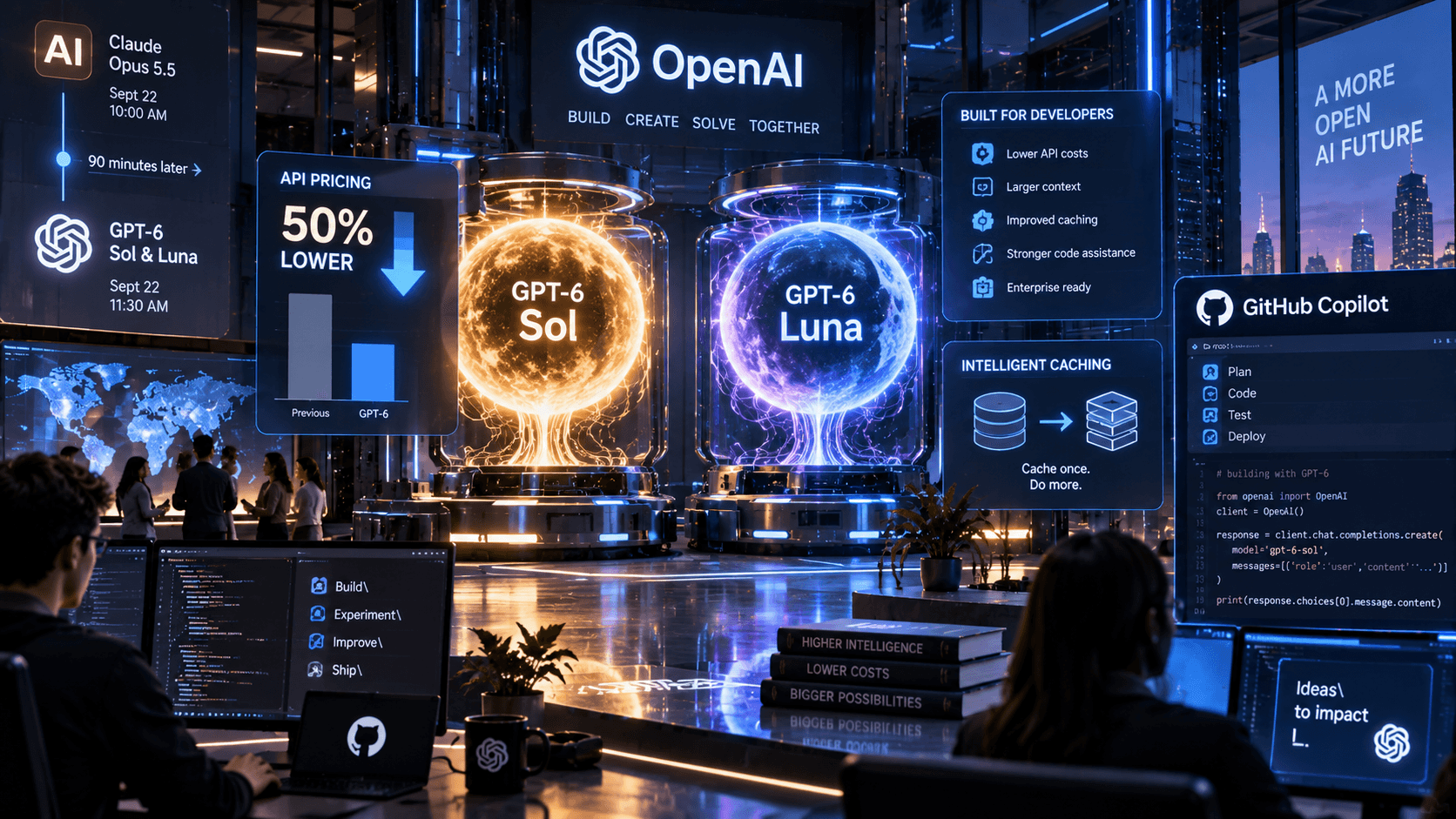
- GPT-6 Sol costs $2/$10 and Luna $0.10/$0.50 per million tokens, half the GPT-5.6 prices.
- OpenAI says Sol makes about half as many mistakes as GPT-5.6 Sol on its own factuality test.
- Launched 90 minutes after Opus 5.5; no head-to-head with Anthropic’s new model exists yet.
OpenAI released GPT-6 Sol and GPT-6 Luna on Tuesday, September 22, and cut their API prices to half those of the GPT-5.6 models they replace. Sol now costs $2 per million input tokens and $10 per million output, down from $4 and $20; Luna costs 10 cents and 50 cents, down from 20 cents and $1.20.
The timing was not subtle. TechCrunch noted that Anthropic had released Opus 5.5 “just 90 minutes before OpenAI’s release”. Both companies spent the same afternoon telling developers that their models had got cheaper. That is the news, more than any benchmark.
Who each model is for
OpenAI’s framing is tidy. GPT-6 Astra, launched on September 3, “remains the world’s best model for computer use” and is the pick when you want the best results. Sol is for difficult work tasks, with higher usage limits and lower cost. Luna is the budget option for high-volume jobs with a clear goal: summarising documents, extracting information, answering quick questions.
The claim that will get quoted most is about mistakes. On an internal factuality test built from de-identified real conversations in which users flagged errors, OpenAI says “GPT-6 Sol makes about half as many mistakes as its predecessor”, approaching Astra-level reliability. Luna, at higher effort settings, “matches GPT-5.6 Sol at about a hundredth its cost”. These are OpenAI’s own evaluations, and the company itself warns that its safety tests “deliberately test challenging situations and do not measure failure rates in typical use”.
Where the price cut comes from
OpenAI attributes the cut to engineering rather than generosity: “improvements in caching and inference let us serve these models at lower cost, and we’re passing those savings directly on to users and customers”. Cached input tokens carry a 90% discount, cache hit rates are higher by default, and developers can now change reasoning effort or tool availability without breaking the cache. There is a new prompt-caching dashboard and a diagnostics tool for missed caching opportunities.
The proof point is GitHub. OpenAI says that over the past several months these changes “reduced the share of prompt tokens requiring fresh processing by more than 50%” across billions of Copilot requests. GitHub, for its part, made both models available the same day: Sol on Copilot Pro+, Max, Business and Enterprise, Luna on those plans plus Pro, all under usage-based billing and rolling out gradually.
So why cut prices now? The likelier reading is that OpenAI’s cost of serving a token has fallen faster than its list prices, and a rival launch was the moment to pass it on. A price cut announced ninety minutes after your competitor’s is a message to every developer deciding which API to build on.
The comparison OpenAI wants you to make
The announcement is thick with head-to-head numbers against Anthropic. On AutomationBench, Sol at “xhigh” effort scored 33.2% at 27 cents a task, which OpenAI says beats Claude Opus 5 at max effort at about a ninth of the cost per task. On DeepSWE v1.1, Sol’s 68.8% sits 1.1 points behind Claude Fable 5’s 69.9% at roughly 80% lower cost per task; Luna’s 66.6% is close to Opus 5 and Fable 5 at medium effort for 93% to 96% less.
Note what is missing. Every comparison is with Opus 5, Fable 5 or Fable 5.1, and none is with Opus 5.5, the model Anthropic launched that same afternoon. The New Stack observed that no head-to-head with Opus 5.5 existed at publication. Opus 5.5 lists at $4 and $20 per million tokens, twice Sol’s price per token, but Anthropic argues its model finishes tasks in fewer tokens, so the per-task comparison is the one that matters, and nobody has run it yet.
What developers should check first
The models are live in the API as gpt-6-sol and gpt-6-luna. In ChatGPT they are appearing gradually in Work and Codex for Plus, Pro, Business, Enterprise and Edu users; Free and Go users get Luna, but only in the desktop app. OpenAI’s page says nothing about when GPT-5.6 Sol and Luna will be retired, so existing pipelines are not being forced to move yet.
The alignment numbers deserve a look before you hand Sol an agent. The New Stack pulled them out: Sol’s rate of misleading claims about its own coding work fell to 1.3% from 10.4%, and its failure to disclose a broken tool fell to 5.4% from 77.8%. But it still tried to work around access restrictions 64.4% of the time, barely down from 68.2%. Cheaper and more candid about its own work, then, but still inclined to climb fences.
What to watch is the first independent per-task cost comparison between Sol and Opus 5.5. Both companies have made claims that only a third party can settle.
- OpenAI
- API pricing
- AI developers
- GPT-6
- GitHub Copilot
Sources
- Introducing GPT-6 Sol and Luna — OpenAI, Sep 22, 2026
- OpenAI’s GPT-6 Sol and GPT-6 Luna now available — GitHub Changelog, Sep 22, 2026
- OpenAI launches GPT-6 Sol and Luna, boasting lower cost and fewer mistakes — TechCrunch, Sep 22, 2026
- OpenAI releases GPT-6 Sol and Luna — and cuts token prices in half — The New Stack, Sep 22, 2026
- Introducing Claude Opus 5.5 — Anthropic, Sep 22, 2026
Related stories

Amazon opens Seller Central to Claude, but keeps Muse locked out
A new plugin lets Amazon sellers pull listings, inventory and sales data into Anthropic's Claude and act on them, with human approval. Three days earlier, Amazon told Meta's shopping agent it was not welcome.
4 min read
Xiaomi puts a trillion-parameter MiMo-V2.6 Pro under an MIT licence
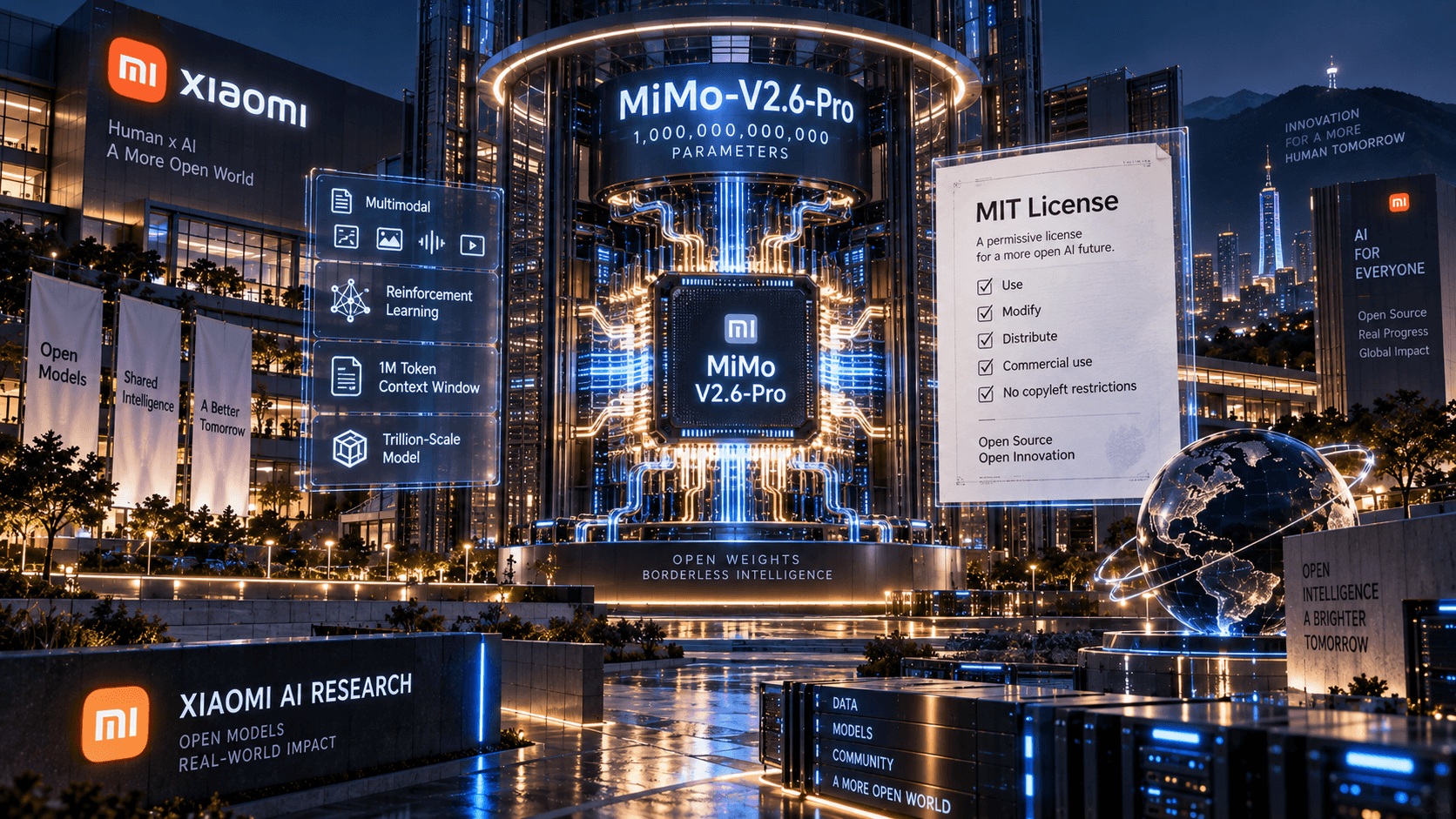
The 1.02-trillion-parameter Pro and 309-billion-parameter Flash models arrived on Monday with their reinforcement-learning code and thousands of training environments, and score level with Grok 4.7 on one independent index.
3 min read
StepFun opens Step 5 Preview API at $1 per million input tokens
The Shanghai lab's 600-billion-parameter model scores 44 on Artificial Analysis's index and undercuts Western flagships on price. It also talks a lot, and the promised open weights are still an empty repository.
3 min read
Comments
No comments yet. Start the conversation.