Blue Cross says hospital AI coding tools added $942m in costs
The insurers' association says more patients were billed as complex without getting more treatment. Hospitals answer that their patients really are sicker, and that insurers use AI too.
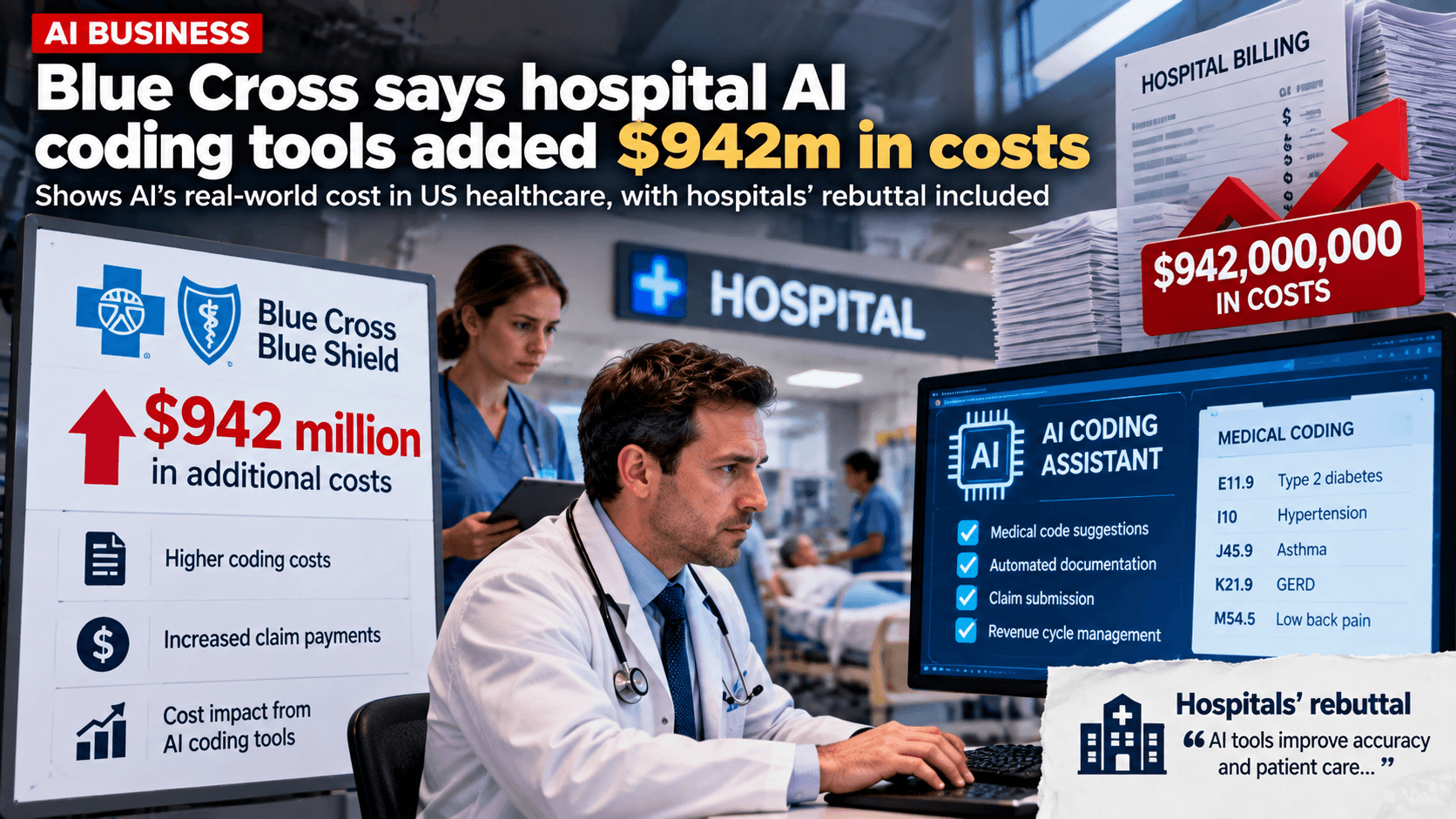
Key takeaways
- Blue Cross insurers say hospitals' AI coding tools added about $942m in costs over two years.
- Complex inpatient cases rose from 37% to 40% of Blue plan claims without more treatment.
- Hospitals say patients are sicker, citing a 5% rise in case-mix index from 2019 to 2024.
Hospitals' use of AI billing and documentation tools added an estimated $942 million in costs for Blue Cross Blue Shield insurers over two years, the Blue Cross Blue Shield Association said on Thursday, September 24. Its claim is that the money paid for more complicated diagnoses on claims, not for more care.
The central number looks small on its face. The share of inpatient cases billed to Blue plans as medically complex rose from 37% at the start of 2023 to 40% by the end of 2025. The association says $653 million of the extra cost came from secondary diagnoses, the additional conditions listed on a claim, which pushed more than 55,000 cases into higher-paying categories at about $11,000 per case.
More diagnoses, the same treatment
The argument rests on what did not change. "If patients are truly sicker, we'd expect to see more treatment," Luke Chalker, the association's senior vice president of product and data science, told Reuters. His conclusion: "AI is identifying more billable conditions, not sicker patients".
The examples are specific. In major bowel procedures, claims at the highest level of complexity rose from 10.2% to 22.7%, while non-complex cases fell from 36.6% to 32.8%. Top-quartile hospitals diagnosed anemia at a rate 38% higher than their peers, yet transfused fewer of those patients, 16.9% against 19.3%. "If it was worth coding, there should have been something done," said Razia Hashmi, the association's vice president of clinical affairs.
Where does AI come in? Reuters describes providers using software that scans existing patient records for conditions, and ambient scribes, which passively listen to conversations with patients. Fierce Healthcare cites a June survey in which more than 63% of healthcare organisations said they use AI in their revenue cycle work.
The insurers' second study, and its limits
This is the association's second pass at the subject. A report in March looked at postpartum anemia in maternity admissions. At high-growth hospitals, the share coded with it went from 4.0% in the second quarter of 2022 to 12.3% by the first quarter of 2025, and that 8.3-point rise came with only a 0.4-point increase in transfusions.
The new analysis has a limit the association itself acknowledges: it relies on claims rather than clinical documentation, which would be a more direct test of whether patients were really sicker. It also comes from the trade body of the companies that pay the bills. That makes it one side's case, not a verdict.
The hospitals' answer
Hospitals reject the premise. The American Hospital Association argued in a fact sheet this summer that hospitals "are increasingly caring for patients with higher acuity, a trend that is appropriately reflected in provider coding practices". It says hospital case-mix index, a standard measure of how sick patients are, rose by about 5% between 2019 and 2024. And it accuses some commercial insurers of using "unsubstantiated allegations of provider upcoding" to cut payments, often through automated "downcoding" edits.
Hospitals also say they are the ones outgunned. HCA Healthcare's finance chief, Mike Marks, said on September 15 that hospitals are "behind the payers" on AI-driven claims processing.
Software on both ends of the same bill
Put the two sides together and you have software on both ends of the same claim: hospital tools that find more to code, insurer tools that find more to cut. Neither side's numbers have been checked by anyone independent, and neither side has put patient charts on the table. The patients and employers who fund the system through premiums are not part of the argument.
What to watch is whether regulators or large employers ask for chart-level audits, and whether the association's March recommendation, that coded severity be tied to "objective clinical indicators and treatment", starts turning up in contracts between insurers and hospitals.
- Healthcare AI
- Medical coding
- Health insurance
- Ambient scribes
- Blue Cross Blue Shield
Sources
- AI tools generated nearly $1 billion in extra costs, Blue Cross insurers say — Reuters (via 93.3 The Drive), Sep 24, 2026
- Hospitals' use of AI coding tools cost BCBSA plans $942M more for similar care: analysis — Fierce Healthcare, Sep 24, 2026
- Hospitals say they're losing the AI billing war. A new BCBS study suggests otherwise — Becker's Hospital Review, Sep 24, 2026
- Rising Coding Intensity and Its Impact on Health Care Affordability — Blue Cross Blue Shield Association
- Fact Sheet: Artificial Intelligence and Coding Intensity — American Hospital Association, Jul 31, 2026
Related stories

Microsoft pledges $10bn-plus for Gulf cloud and AI despite the war
Brad Smith says Microsoft is keeping every investment it planned before the conflict began on February 28 and adding to them: more than $10 billion across the UAE, Saudi Arabia, Qatar and Kuwait by 2030, plus $400 million for cables.
3 min read

UK regulator wants AI assistants on Google’s choice screens
The CMA has reversed January’s exclusion of chatbots from the search choice screens Google must show Android and Chrome users, and kept the annual prompt Google objected to. Consultation closes October 9.
3 min read

Newsom signs seven data-centre laws on power costs, water and land
The bills signed on Monday create separate electricity tariffs for loads of 75 megawatts and more, require water-use disclosure before local approval, and pull data centres out of blanket environmental-review exemptions.
3 min read
Comments
No comments yet. Start the conversation.