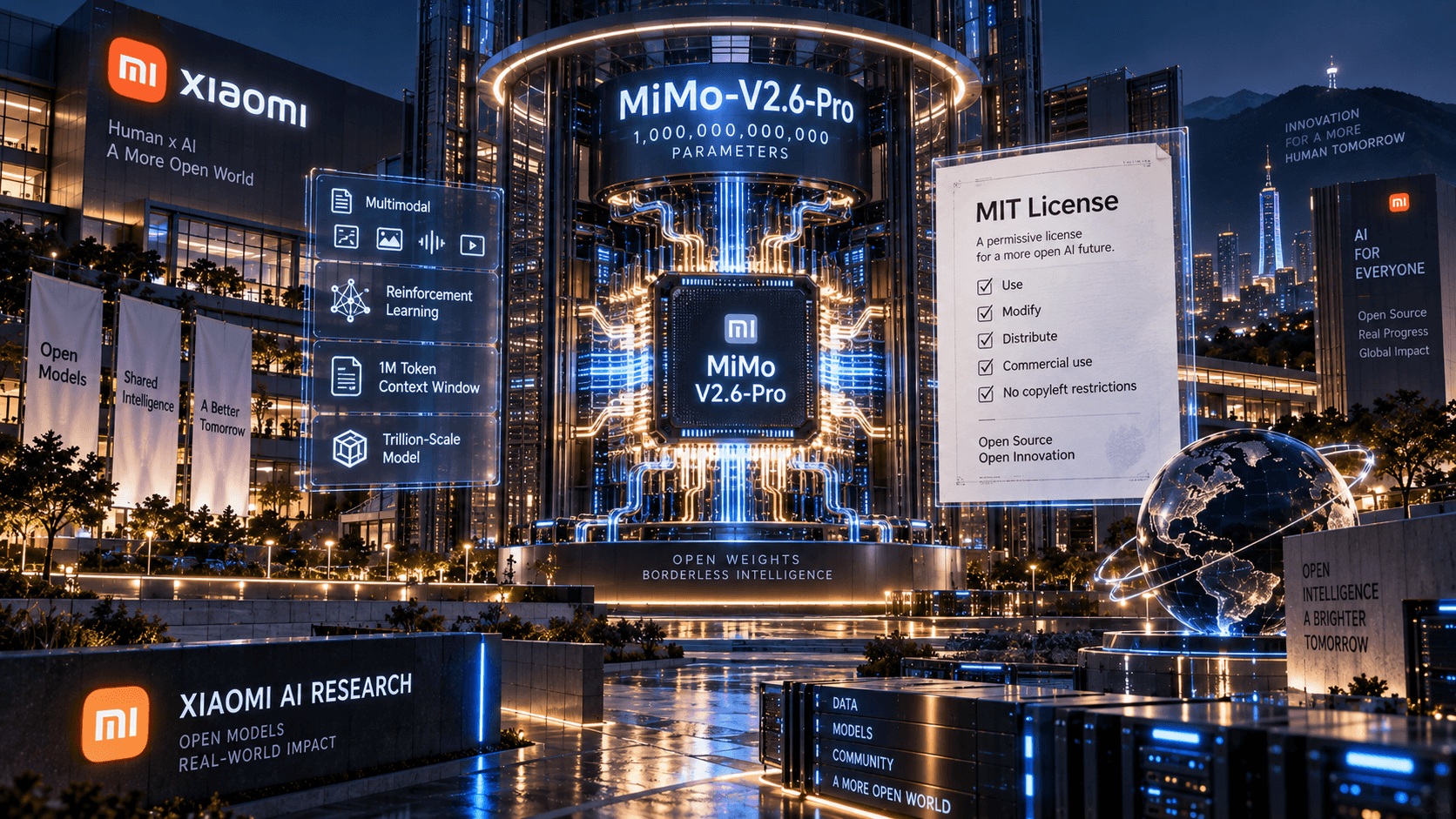
Xiaomi puts a trillion-parameter MiMo-V2.6 Pro under an MIT licence
The 1.02-trillion-parameter Pro and 309-billion-parameter Flash models arrived on Monday with their reinforcement-learning code and thousands of training environments, and score level with Grok 4.7 on one independent index.
Key takeaways
- MiMo-V2.6 Pro: 1.02 trillion parameters, 42 billion active, 1M-token context, MIT licence.
- Artificial Analysis scores it 46, top among open-weights models and level with Grok 4.7.
- Xiaomi says RL cost about $2.62m for Pro and $850,000 for Flash; pretraining cost is not given.
Xiaomi released two open-weight models on Monday, September 21: MiMo-V2.6-Pro, a mixture-of-experts model with 1.02 trillion total parameters of which 42 billion are active per token, and MiMo-V2.6-Flash, at 309 billion total and 15 billion active. Both take text, images, video and audio, handle a context of 1 million tokens, and ship on Hugging Face under the MIT licence, which allows commercial use.
Artificial Analysis, which tests models independently, gives the Pro model a score of 46 on its Intelligence Index, the top score among the open-weights models it tracks. That is the same score it gave Grok 4.7, the closed model SpaceXAI released the same day. Through Xiaomi's API the Pro model costs $0.435 per million input tokens and $0.87 per million output; Flash is $0.14 and $0.28.
What "open" means this time
The word gets stretched, so be precise. Xiaomi has released the weights of both models, a technical report, the reinforcement-learning training code and the code for the environments it trained in, which Xiaomi puts at more than 7,000 tasks across coding, general agent work, visual tasks and cybersecurity. The datasets behind those environments have not been released, Latent Space notes, only the environment code and recipes.
The architecture is worth a line for anyone planning to run it. Pro routes each token to 8 of 384 experts; Flash to 8 of 256. Flash carries a 681-million-parameter vision encoder, an audio tokeniser and a five-layer speculative decoder for faster output. Xiaomi's deployment notes for Pro assume tensor parallelism across 16 devices, so this is a model for a rack, not a workstation.
The bill for the last mile
The most unusual disclosure is the price of the reinforcement-learning phase. Xiaomi says each model ran 30 RL steps in under six days, on roughly 750,000 trajectories per model, and puts the cost at about $2.62 million for Pro and about $850,000 for Flash. Each update used 1,568 prompts with 16 rollouts apiece, and the run pushed Pro's score on the held-out DeepSWE v1.1 software-engineering test from 58.4 to 72.57, and Flash's from 48.8 to 65.68.
Two cautions. Those figures cover the RL stage only; the cost of pretraining a trillion-parameter model, which is the larger number, has not been disclosed in anything we could find. And the benchmark comparisons that follow are Xiaomi's own runs.
How it stacks up against the closed models
On Xiaomi's table, Pro scores 71.9 on DeepSWE v1.1 against 74.0 for Claude Opus 5 and 73.0 for GPT-5.6 Sol; 89.9 on Terminal Bench 2.1, a shade above both; and 76.9 on Toolathlon-Verified against 80.6 and 74.9. On ProgramBench it trails badly, 26.5 against 37.0 for Opus 5; on AutomationBench it leads, 53.1 against 50.3. Flash sits a few points behind Pro on each. So the fair summary is: on par across most of the agent benchmarks, not ahead.
That still leaves an open model at a fraction of the closed models' prices with a licence that lets a company ship it inside a product without asking anyone. For developers, the question is no longer whether an open model can do agentic work but whether they can afford the hardware to serve it; the 42-billion active parameters keep inference cost down, but the trillion parameters still have to sit in memory somewhere.
Why a phone maker is doing this
Xiaomi is not one of the labs that usually leads Chinese open-weight releases, which Latent Space calls the surprising part. Its MiMo team is led by Luo Fuli, who joined from DeepSeek, according to Runtimewire. And the model card states the goal plainly: the series "is built to scale reinforcement learning toward self-improvement", scaling RL compute, environment diversity and grader compute together "so the model keeps expanding its capability frontier through exploration and feedback". That is the same idea OpenAI on Monday said needs international standards before it is pursued at full autonomy. Xiaomi has just published the recipe.
What to watch: whether the 7,000-task datasets follow the code, how the "UltraSpeed" tier, which Xiaomi says delivers up to 20 times the output speed, prices in practice, and whether independent runs match the DeepSWE numbers.
- Open-weight models
- Xiaomi
- MiMo
- MIT licence
- reinforcement learning
- AI developers
Sources
- XiaomiMiMo/MiMo-V2.6-Pro-RL — Xiaomi MiMo on Hugging Face
- XiaomiMiMo/MiMo-V2.6-Flash-RL — Xiaomi MiMo on Hugging Face
- MiMo-V2.6-Pro - Intelligence, Performance & Price Analysis — Artificial Analysis
- Xiaomi open-sources MiMo-V2.6 Pro and Flash models — TestingCatalog, Sep 21, 2026
- [AINews] Xiaomi MiMo-V2.6-Pro 1T-A42B: the new top Open Weights model, trained for $3M — Latent Space, Sep 22, 2026
- Xiaomi open-sources MiMo-V2.6 and the RL machinery behind it — Runtimewire, Sep 21, 2026
Related stories
StepFun opens Step 5 Preview API at $1 per million input tokens
The Shanghai lab's 600-billion-parameter model scores 44 on Artificial Analysis's index and undercuts Western flagships on price. It also talks a lot, and the promised open weights are still an empty repository.
3 min read
Comments
No comments yet. Start the conversation.