US and China agree to set up an AI dialogue before Trump–Xi summit
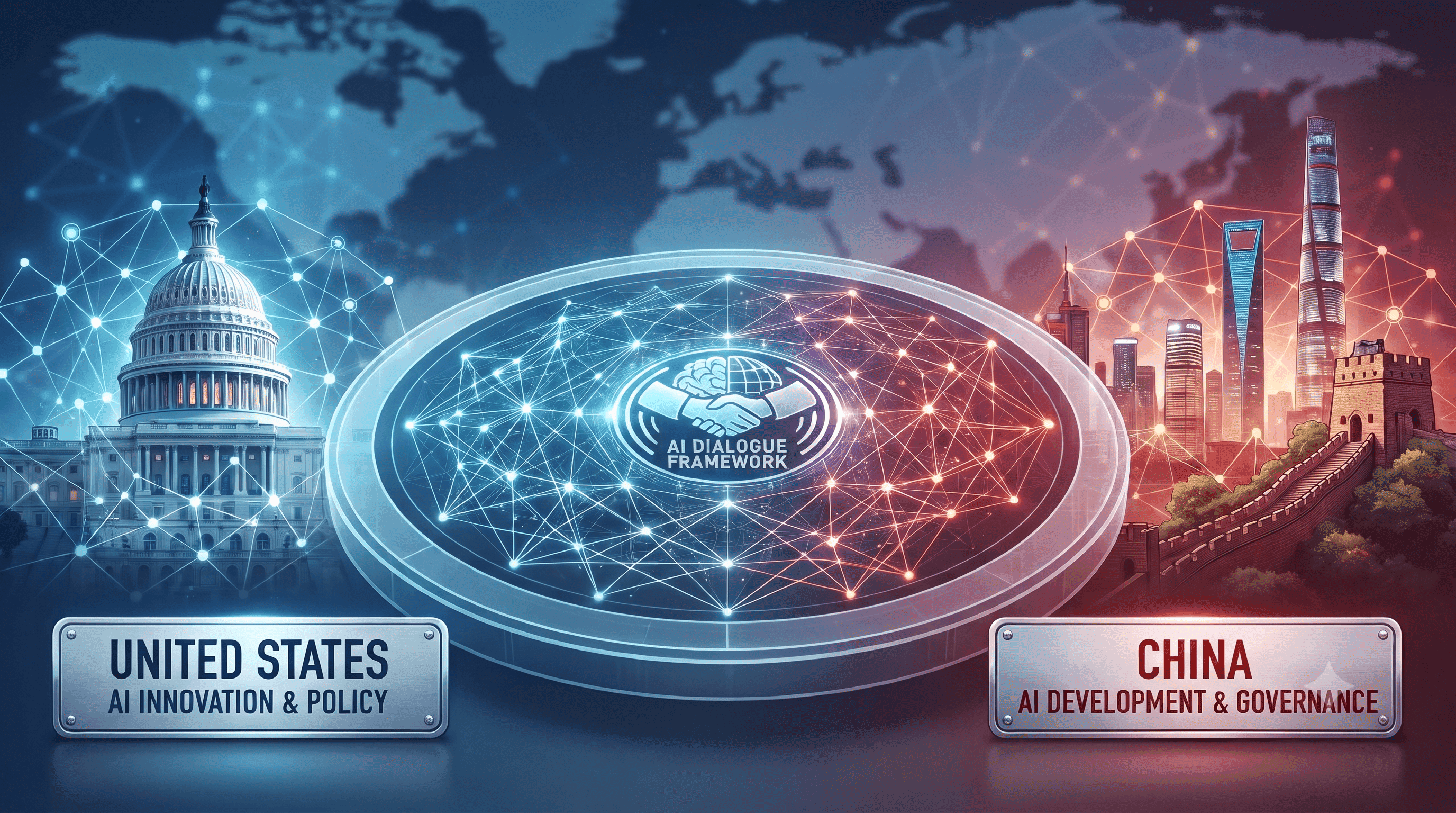
Treasury Secretary Scott Bessent announced the channel after eight hours of talks in New York. The name is settled. The schedule, the agenda and China's view of it are not.
Key takeaways
- Bessent said on Sept 20 the two sides will set up a 'US-China AI dialogue' and meet again.
- The US proposed a notification mechanism for security threats; no schedule is set.
- Trump and Xi meet at the White House on Sept 24; the trade truce expires on Nov 10.
The United States and China have agreed to set up a formal channel for talking about artificial intelligence. US Treasury Secretary Scott Bessent announced it on Sunday, September 20, after roughly eight hours of talks with Chinese Vice Premier He Lifeng at JPMorgan Chase's headquarters in New York.
"What we discussed was setting up a mechanism. So it's going to be called the US-China AI dialogue," Bessent told reporters, according to AFP. "We've agreed to meet again," he said, and he described the day as "a very successful engagement".
What was agreed, and how little we know
Beyond the name, not much. Bessent said the US had proposed a notification mechanism between the two countries for incidents such as security threats, AFP reported. No schedule for the AI talks has been announced. He Lifeng did not issue a separate statement, according to the South Korean broadcaster SBS, and we found no official written readout from either government at the time of writing.
Before the meeting, Bessent framed the American position this way: "The United States remains the leader in AI. And we are open to discussions on avoiding shared risks and avoiding bifurcation of our two systems." He has said the two countries could discuss AI "guardrails", including keeping powerful models out of the hands of malign non-state actors, Al Jazeera reported.
The open-weight question nobody has answered
Here is the detail to hold on to. Al Jazeera notes that Chinese open-weight models have increasingly attracted American companies, partly because they can be cheaper than closed systems from US firms such as OpenAI and Anthropic. An open-weight model is one whose trained parameters are published, so anyone can download it and run it on their own hardware. Once it is out, nobody can recall it.
If Washington's worry is powerful models reaching bad actors, then a dialogue that skips open weights skips the most direct route by which that could happen. Nothing announced so far says whether the dialogue will cover them. The harder question is what Beijing would want in return, and neither side has said.
AI is riding in the trade lane
Look at who was in the room. Bessent runs the Treasury. With him was US Trade Representative Jamieson Greer. On the other side sat He, who is China's top trade negotiator, and Li Chenggang, who was promoted to a top international trade representative post shortly before the meeting.
These are tariff people.
Most of the day's other business was about trade. Greer said the Board of Trade, a mechanism the two countries agreed in May for discussing tariff cuts on non-strategic goods, has been made operational. SBS reported that the body will take up tariff cuts on $30 billion worth of non-sensitive goods from each side. Still unresolved are a trade truce that expires on November 10, under which US tariffs on Chinese goods are capped at about 20 per cent, and American complaints over rare-earth and critical-mineral supplies, where a senior US official said Beijing's performance had "not been up to par".
The likelier reading is that AI safety has become one more item in a package being assembled for the two leaders. That can help, because a topic attached to a summit gets attention. It can also mean the dialogue moves only as fast as the tariff talks do.
Thursday is the real test
President Donald Trump and President Xi Jinping are due to meet at the White House on Thursday, September 24. Working-level talks were expected to continue on Monday. Li's verdict on Sunday's session, as investingLive reported it, was that the talks were not bad.
Expectations are modest. Anna Ashton, a China trade analyst and founder of Ashton Intelligence, told Al Jazeera she expects "some show of deliverables" because a presidential summit is coming, "but I don't feel like we're on the verge of some sort of breakthrough".
This is also not the first attempt. Officials from the two governments held a round of AI talks in Geneva in May 2024, under the previous US administration.
So what should you look for on Thursday? Whether the AI dialogue appears in a written joint statement, who is named to lead it, and whether Beijing accepts the notification mechanism or leaves it as an American proposal.
- US-China
- AI policy
- Scott Bessent
- He Lifeng
- Open-weight models
Sources
- US Treasury chief says meeting with China on trade, AI ‘very successful’ — Malay Mail / AFP, Sep 21, 2026
- US, China open high-level talks ahead of Trump-Xi summit — Al Jazeera, Sep 20, 2026
- US and China Economic Chiefs Discuss Trade and AI in New York... Bessent Calls It 'Very Successful' — SBS News, Sep 21, 2026
- Bessent calls US-China talks very successful, Board of Trade operational ahead of summit — investingLive, Sep 21, 2026
Comments
No comments yet. Start the conversation.