Claude pushes a particle-physics calculation to nine loops
A physicist’s account on Anthropic’s science blog says Fable 5.1 ran a known recipe for about a week and went one loop past the record. The theory is a testbed, not the real world.
Key takeaways
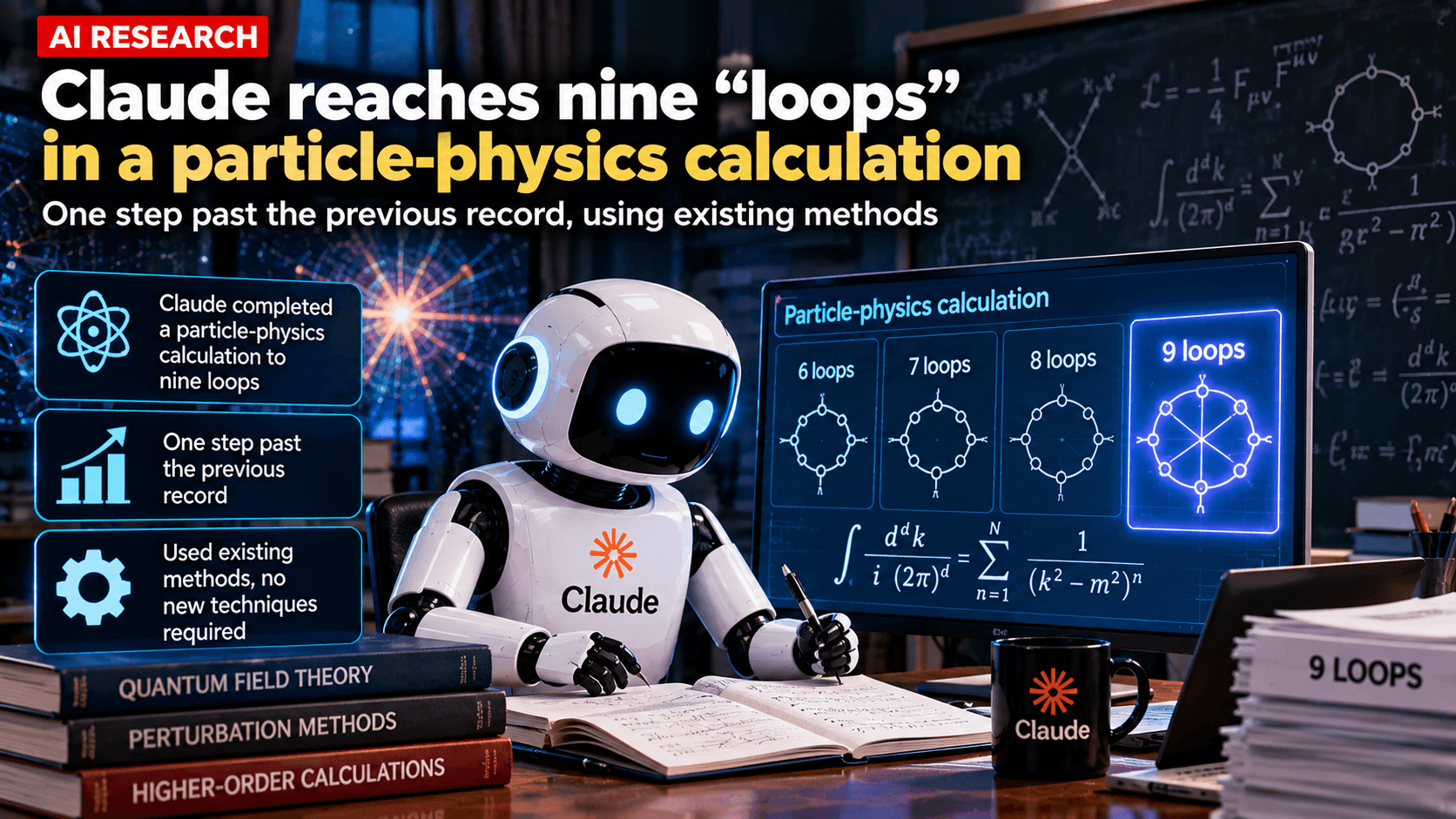
- Claude Fable 5.1 computed a six-particle amplitude at nine loops; the previous best was eight.
- The work used known methods and would have cost a user about $1,000 to $2,000 in model time.
- SLAC’s Lance Dixon checked it; the theory it applies to is not used for real-world physics.
Anthropic says its Claude Fable 5.1 model has computed a particle-physics quantity at nine “loops”, one step beyond the eight-loop result human physicists reached a few years ago. The account, published on Anthropic’s science blog on September 25, was written by physicist Matt von Hippel, with an addendum from Lance Dixon of the SLAC National Accelerator Laboratory, who checked the result.
Running the whole thing would have cost an ordinary user around one or two thousand dollars, the post says, and it used methods humans had already built.
What a “loop” means here
Physicists predict how particles scatter using formulas called scattering amplitudes. Each extra loop is a finer correction: the more loops, the closer to the real answer, and the harder the calculation becomes. The object in this case is the six-particle amplitude in planar N=4 super Yang-Mills, a simplified cousin of the theories used for real-world predictions. Von Hippel is plain about that: the theory “isn’t used as an explanation for dark matter, or for anything in the real world”.
Dixon helped build the method from the start. In 2023 he and Andy Liu used it to reach eight loops.
How the model did it
Two Anthropic physicists, Liam Fitzpatrick and Siddharth Mishra-Sharma, gave the model the problem and told it to keep going while they slept. It ran inside Claude Science, a platform scientists pay to use, and tried two independent routes to the answer. The core “bootstrap” step, written in Python with the SymPy library, used about $100 of the budget, equal to running 96 processors for a week.
Dixon validated the output mainly by working back from the amplitude to a related quantity, the nine-loop form factor, which his own team had been chasing for a couple of years. “It’s quite a triumph, in my opinion, for a large language model to execute all of the steps,” he writes. He adds that Claude “understands our 2019 and 2023 papers better than any human, aside from my co-authors”.
What it is not
It is not a new idea. Von Hippel says Claude “used known methods, with a bit more compute than people had tried to use before”. Peter Woit, who writes the Not Even Wrong blog at Columbia University, made the same point: “It appears that Claude did not come up with a new method, just used known calculational methods”.
It is also not unique. A group led by Song He at the Chinese Academy of Sciences in Beijing had “already gotten the majority of the result”, von Hippel writes, with help from OpenAI’s GPT-6 on some of the constraints, though not the almost hands-off approach Anthropic used.
So why does it matter? Mostly because of labour. Von Hippel says he got to see seven loops as a PhD student “before I started losing steam”, and his main lesson is that “there is more low-hanging fruit out there than you’d expect”. Calculations that stall because they are long and fiddly, rather than conceptually hard, now look within reach of a model, a budget and a patient physicist to check the work.
The line it did not cross
Dixon draws that line himself: “The more soul-searching moments will come when large language models start to come up with new physical principles and insights before humans”. This result does not get there.
The full nine-loop result has been posted in the same format as the earlier loop orders, so others can check it. The tests to watch are whether independent groups confirm it, and whether the same approach carries over to amplitudes in theories that describe real particles.
- Anthropic
- Claude
- AI for science
- Physics
- Research
Sources
- Yes, Claude can do Nine Loops — Anthropic, Sep 25, 2026
- Some HEP-TH News — Not Even Wrong (Peter Woit), Sep 25, 2026
Related stories

Anthropic's book-swap test: agents' weak spot was reading tastes
In Project Swap, 201 Anthropic employees let Claude agents trade physical books for them. Most of the shortfall came from misjudged preferences rather than bargaining, and stronger models won.
3 min read
Anthropic says Claude agents found a new enzyme system in 21 hours
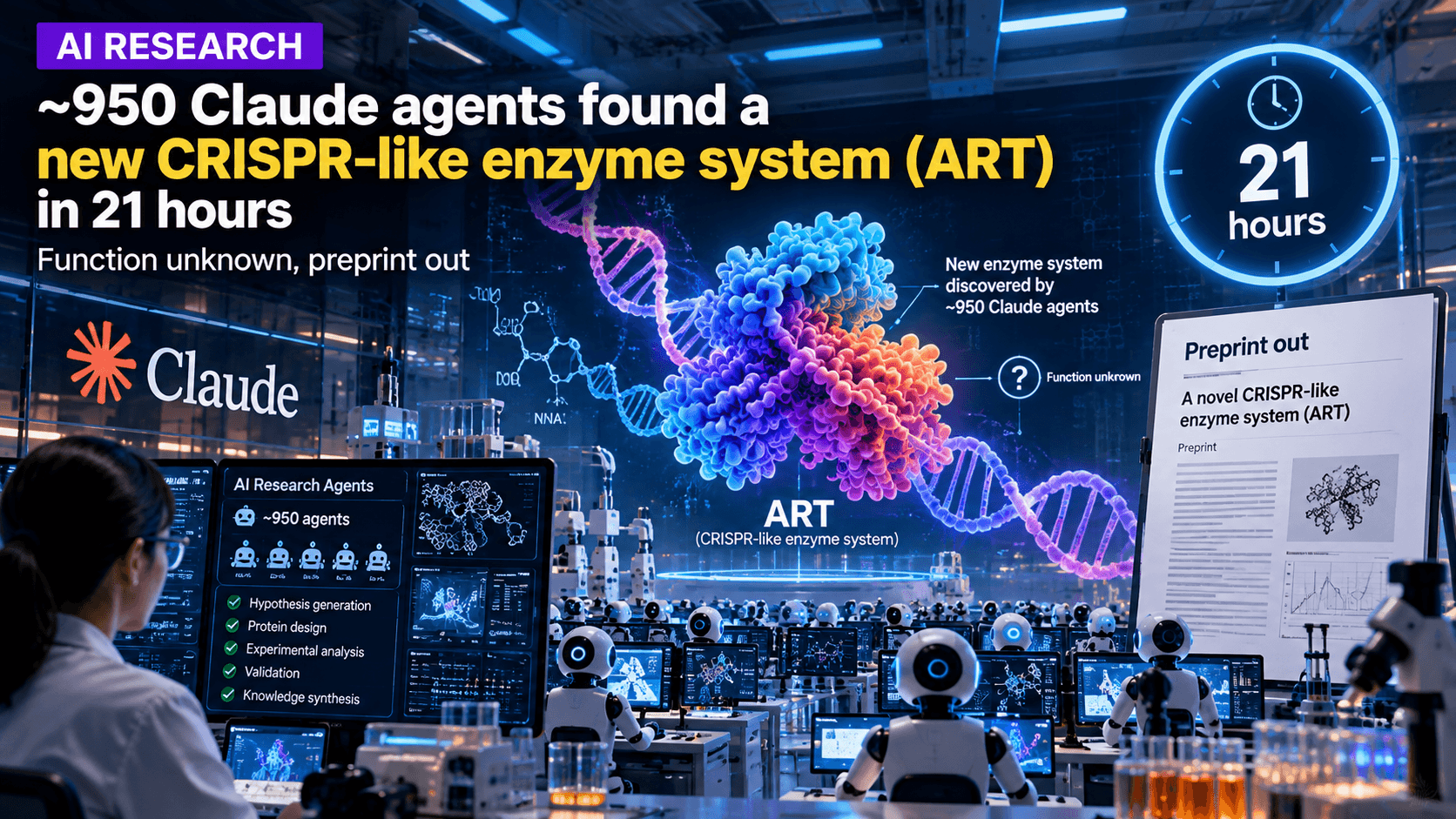
About 950 Claude agents combed a DNA database and picked out a reverse transcriptase sitting beside a CRISPR-like array of repeats. Anthropic's human scientists have started characterising it in the lab. What it does is still unknown.
4 min read

Mathematicians solve the last sporadic Galois case with AI help
A six-author paper shows the Mathieu group M23 is a Galois group over the rationals, closing a list open since the 1980s. The acknowledgments credit Claude and ChatGPT; the text, the authors say, is all human.
3 min read
Comments
No comments yet. Start the conversation.