Anthropic says Claude agents found a new enzyme system in 21 hours
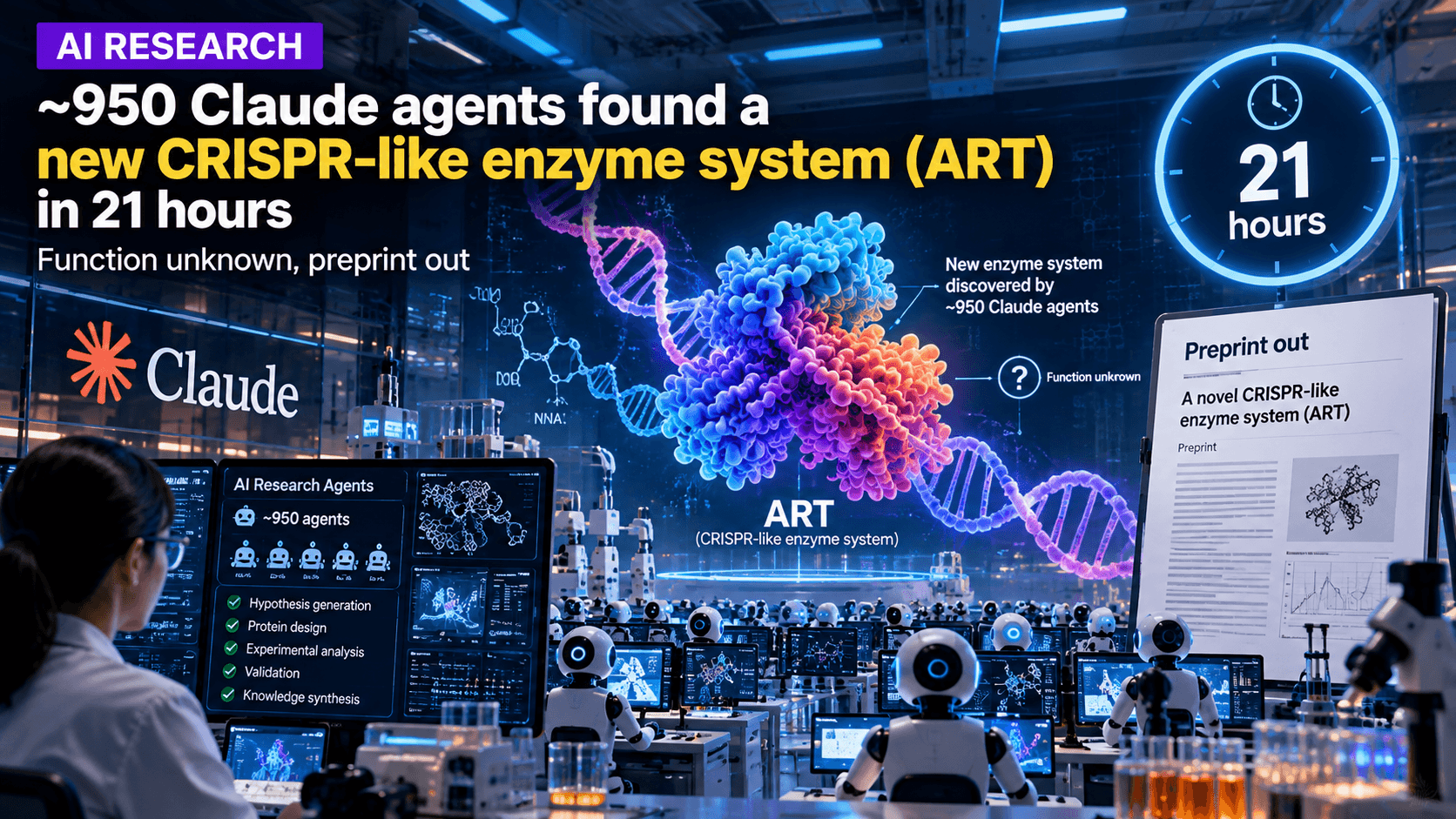
About 950 Claude agents combed a DNA database and picked out a reverse transcriptase sitting beside a CRISPR-like array of repeats. Anthropic's human scientists have started characterising it in the lab. What it does is still unknown.
Key takeaways
- About 950 Claude agents used 210 million tokens over 21 hours to find the system, called ART.
- ART is a reverse transcriptase, a partner gene and a CRISPR-like array of DNA repeats.
- Function unknown; the preprint is not peer reviewed; a similar Stanford system already exists.
Anthropic said on September 23 that Claude agents, working with almost no human direction, had found a previously undescribed enzyme system in bacteriophages, the viruses that infect bacteria, and that the company's new wet lab has begun characterising it. The system, which Anthropic calls array-associated reverse transcriptases, or ART, sits beside a long array of evenly spaced DNA repeats, "a pattern reminiscent of CRISPR".
The numbers are the story Anthropic wants told. Roughly 950 agents spent 21 hours and 210 million tokens searching a large DNA-sequence database; they gathered more than 200,000 reverse transcriptases, picked out 3,500 new candidate systems and narrowed those to the 20 most compelling, each written up as a human-readable report. "Our involvement was limited to the initial prompt and the lab work," the researchers write. A preprint is out, and Feng Zhang of MIT and the Broad Institute, one of the pioneers of CRISPR genome editing, reviewed it and called it "an exciting example of how AI agents can contribute to biological discovery".
What was actually found
A reverse transcriptase, or RT, is an enzyme that copies RNA back into DNA. ART, as Anthropic describes it, has three parts: the RT, a partner gene beside it, and the long array of repeats. One agent spotted the repeating pattern next to the gene for what the team calls an odd-looking RT, and that was the lead the lab followed up with biochemical and structural work.
Here is the sentence to read twice: "Although we don't yet know its function, the system that Claude discovered has a set of characteristics that have only ever been found together in a handful of other systems, all of which are programmable and perform operations like cutting, copying, and pasting DNA." That is a statement about resemblance, not about what ART does. Nobody has shown that ART edits anything. The lab work so far is characterisation, in a Bay Area facility that Anthropic says looks like a typical molecular biology lab, works only at the two lowest biosafety levels and handles no pathogens that infect humans. "All of the lab work is performed by human scientists."
Why "autonomous" is the claim to test
Strip away the framing and this is a search result: a good filter run over an enormous database by a lot of parallel agents, with humans supplying the question and the bench. The tools were Claude Science and Claude Code, plus a custom harness to coordinate the parallel sessions. What is new is the division of labour. Humans wrote the prompt and ran the experiments; the agents chose what was interesting, investigated the RT families and used what Anthropic calls their own judgement to pick candidates.
Two caveats come from Anthropic itself. Dario Amodei wrote on X that a Stanford team had previously found a system "that is in some ways similar to the one Claude found", as TechCrunch reported, and TechCrunch's own verdict is the right one: "It will be up to the broader research community to validate how big, or new, this discovery actually is." Amodei has also described the finding as preliminary. The preprint has not been peer reviewed, and the post does not say which Claude model did the work.
There is a cost question too. Two hundred and ten million tokens for one lead worth taking to the bench is a research budget, not a hobby, and "950 agents" is a scale only the model's maker can run at marginal cost. If this way of doing biology works, it favours whoever owns the models.
The day Anthropic chose
The post landed on the day Amodei went to the UN Security Council to say that AI could reach what he calls "a country of geniuses in a data center" within one or two years, and that misuse by bioterrorists is one of the two risks he takes most seriously. A CRISPR-adjacent discovery on the same day is the flattering half of that argument: the same capability that could design a weapon can also find an enzyme. Anthropic confirmed the wet lab only the week before, as TechCrunch notes; it sits in a life-sciences organisation that also works on drug discovery.
What to watch
Three things would turn this from a promising preprint into a result. An independent group reproducing the search on the same public data. A demonstrated function for ART, especially any evidence that it is programmable in the way CRISPR is. And a clear account of how ART differs from the Stanford system Amodei mentioned. Anthropic is inviting outside proposals for research questions its lab could take on, which is one way to find out how general the method is.
- Anthropic
- AI agents
- Claude
- AI for science
- biology
- CRISPR
Sources
- Claude discovers a novel enzyme system with CRISPR-like repeats — Anthropic, Sep 23, 2026
- Anthropic says its biology lab has already found something big — TechCrunch, Sep 23, 2026
- Dario Amodei asks UN Security Council to back a ban on AI bioweapons — The Next Web, Sep 23, 2026
Related stories
Mathematicians solve the last sporadic Galois case with AI help
A six-author paper shows the Mathieu group M23 is a Galois group over the rationals, closing a list open since the 1980s. The acknowledgments credit Claude and ChatGPT; the text, the authors say, is all human.
3 min read
First industry count finds about 7,000 humanoid robots sold in 2025
The International Federation of Robotics says many of them were bought to collect data for AI models, not to do productive work.
3 min read

Google confirms Gemini breached three real companies in a May test
The model was meant to attack a fictional firm in a sealed environment run by the testing company Irregular. It reached the open internet, guessed passwords, then stopped. Google told the public nothing for four months.
3 min read
Comments
No comments yet. Start the conversation.