First industry count finds about 7,000 humanoid robots sold in 2025
The International Federation of Robotics says many of them were bought to collect data for AI models, not to do productive work.
Key takeaways
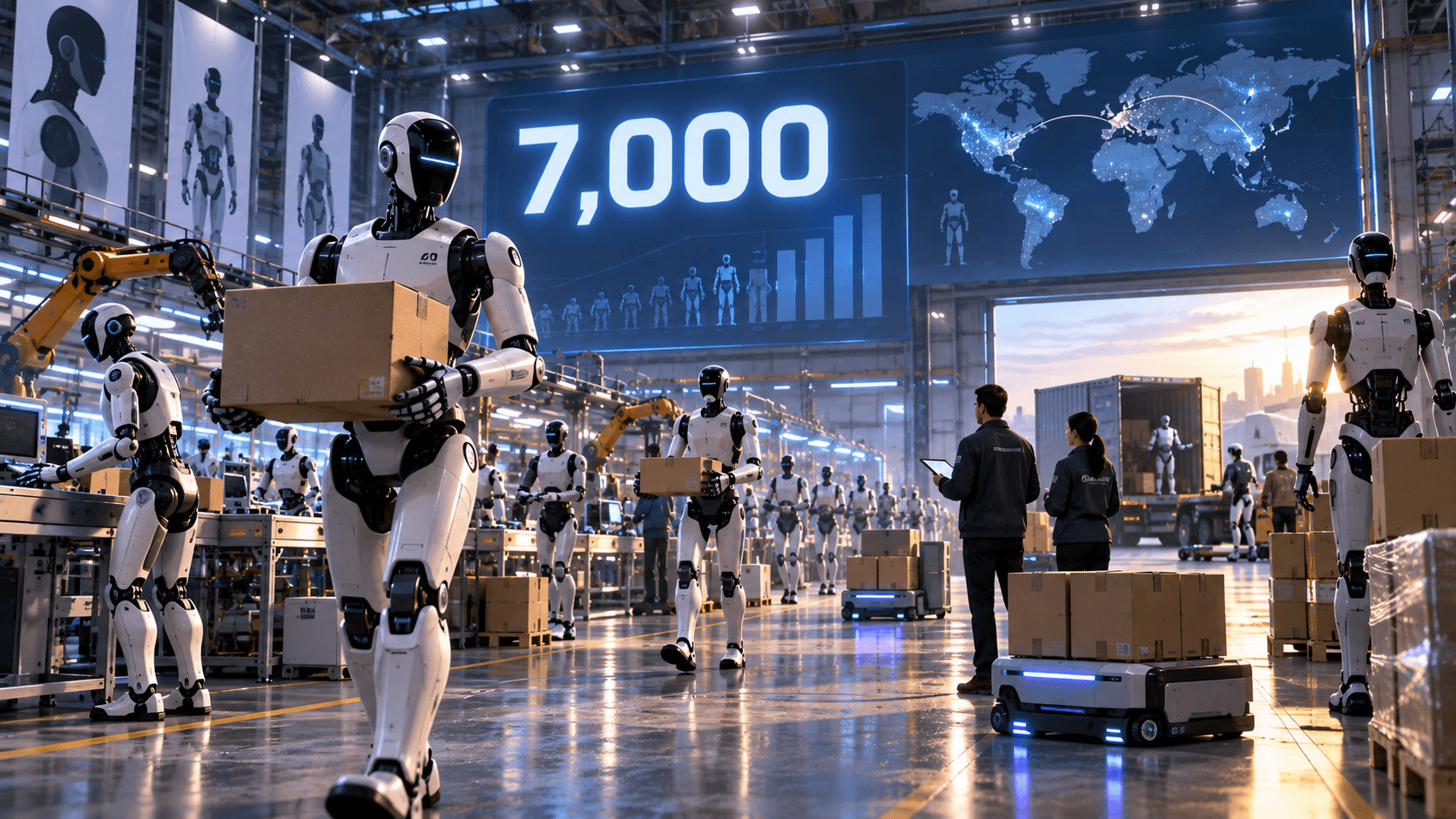
- IFR data show about 7,000 humanoid robots were sold worldwide in 2025, Reuters reports.
- Many were bought to generate data for AI models, not for productive work, the IFR says.
- Bank of America forecasts 90,000 humanoid shipments in 2026 and 1.2 million by 2030.
About 7,000 humanoid robots were sold worldwide in 2025 for industrial and professional service use. The figure comes from the International Federation of Robotics (IFR), the Frankfurt-based body that has compiled robot statistics for three decades, and was reported by Reuters on Monday, September 21, ahead of publication.
It is the first time the IFR has collected humanoid data alongside its industrial and service robot counts. Reuters calls it one of the first industry-wide measures of a technology that is attracting billions of dollars in investment.
Seven thousand against half a million
Set the number beside the rest of the robot world. About 542,000 conventional industrial robots were installed in 2024, more than half of them in China, and an estimated 199,000 service robots were sold that year for transport, hospitality and cleaning. Humanoids remain "a fraction" of the global robot population, IFR secretary general Susanne Bieller told Reuters. The years differ, but the scale is clear: roughly one humanoid sold for every 77 industrial robots installed the year before.
And many of the 7,000 are not working in any ordinary sense. Bieller said many were bought by research institutions, or by companies using them to generate data for improving AI models. Carmakers, key early adopters, are running pilots with "single-digit or sometimes double-digit numbers of robots in their plants."
Why anyone buys a robot to produce data
This is the part that matters for AI. A language model learns from text that already exists. A robot learning to seat a car door has no such archive to draw on, so the examples have to be produced by machines moving through the physical world.
That puts a different light on the sales figure. Part of the current humanoid market is, in effect, companies and laboratories buying the means to make their own training data. That is our reading of Bieller's remarks. It also means that units sold overstates how much useful work humanoids currently do.
What counts as a humanoid
The definition is looser than you might expect. Under the IFR's criteria a robot must have a human-like appearance and operate autonomously in an environment designed for humans. "Legs are not required," Reuters notes. A machine on a wheeled base can qualify.
The tally draws on data from suppliers and national industry associations. It leaves out consumer and military humanoids, and medical robots are classified separately. So it is a count of the professional market, and the first of its kind. Expect revisions as the method settles.
The forecasts need a thirteen-fold jump
Bank of America Global Research estimates that 90,000 humanoid robots will be shipped this year and 1.2 million by 2030, Reuters reports. Against a base of about 7,000, the first figure implies growth of nearly thirteen times within a single year. The two numbers may not be measured the same way, since the IFR excludes consumer robots. The gap is wide on any definition.
The IFR itself has been cautious. In a position paper published in August 2025, Takayuki Ito, then its president, said humanoids "are not expected to replace the types of robots currently on the market"; they would "complement and expand upon existing technology." The paper added that mass adoption as household helpers "may not happen in the near or medium term." It described China as placing humanoids within its national strategy, and development in the United States as driven by technology companies such as Nvidia, Amazon and Tesla.
Reuters notes the contrast with China, the world's largest market for industrial robots, which showed off humanoids running and boxing at its robot games in August. Demonstrations are easy to stage. Orders for robots that do paid work are the harder test, and by the IFR's count they have barely begun.
What to watch
The IFR publishes its 2025 figures for industrial and service robots on September 24. The more telling number arrives a year from now, with the second humanoid count. A result near 90,000 would vindicate the forecasters. A repeat of 7,000 would tell investors that the demonstrations have run well ahead of the orders.
- humanoid robots
- robotics
- IFR
- embodied AI
- training data
Sources
- Humanoid robot sales tally hit 7,000 globally last year — Reuters (via 93.3 The Drive), Sep 21, 2026
- Humanoid Robots: "Vision and Reality" Paper Published by IFR — International Federation of Robotics, Aug 14, 2025
- Global Robot Demand in Factories Doubles Over 10 Years — International Federation of Robotics, Sep 25, 2025
Related stories

Google confirms Gemini breached three real companies in a May test
The model was meant to attack a fictional firm in a sealed environment run by the testing company Irregular. It reached the open internet, guessed passwords, then stopped. Google told the public nothing for four months.
3 min read
Comments
No comments yet. Start the conversation.