Microsoft opens Hyderabad cloud region, its fourth in India, for AI
India South Central is live, with Adani Group, Bajaj Finserv, HDFC Bank and PB Pay signed up. Microsoft has not said how much AI computing capacity the region holds.
Key takeaways
- Microsoft's India South Central cloud region in Hyderabad went live on September 21, 2026.
- Adani Group, Bajaj Finserv, HDFC Bank and PB Pay are the first named customers.
- Microsoft has not disclosed the region's power capacity or how many AI chips it holds.
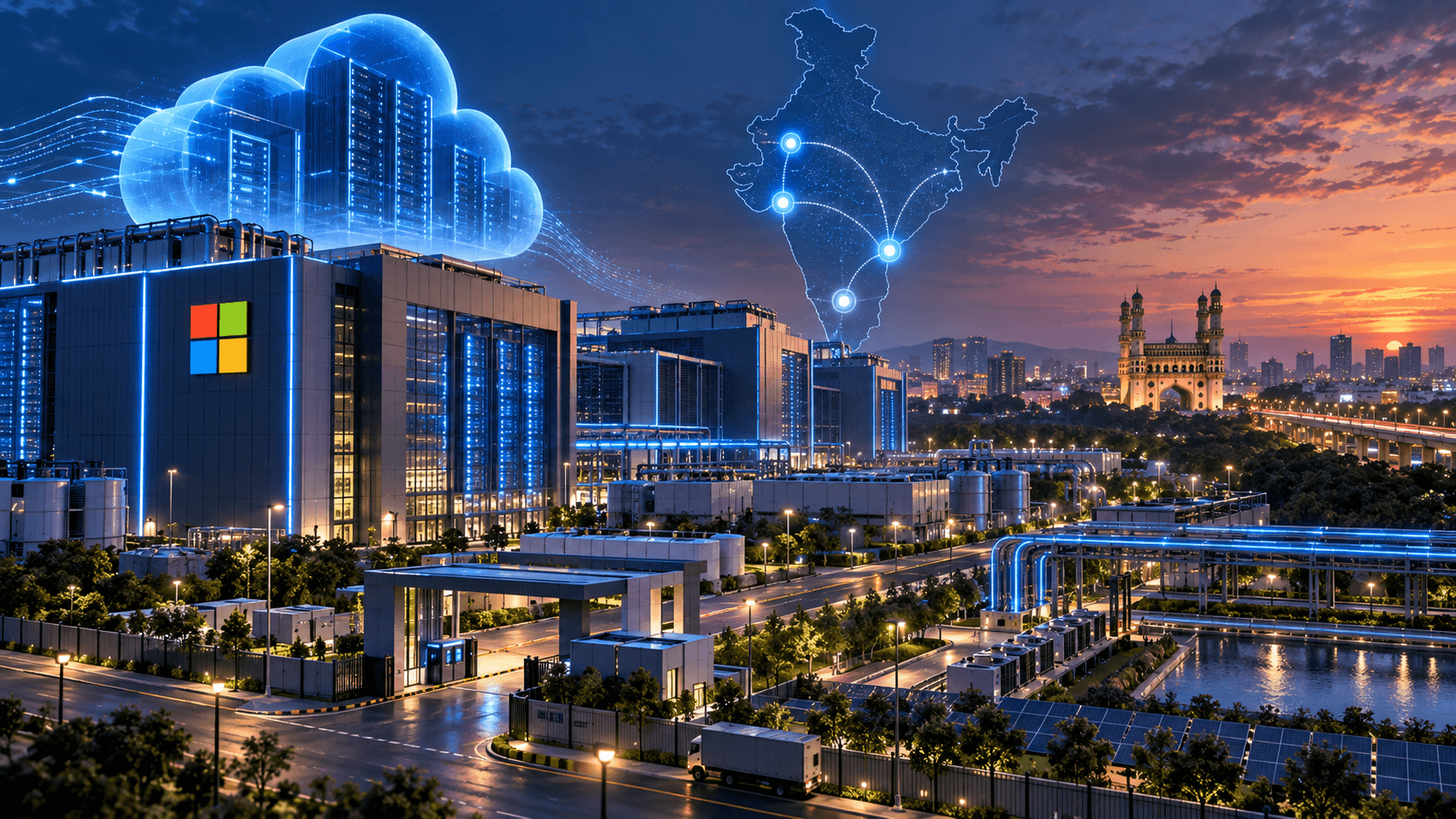
Microsoft switched on a new cloud region in Hyderabad on Monday, September 21. India South Central is the company's fourth cloud region in the country and, in the words of Microsoft India president Puneet Chandok, is "built for advanced AI workloads."
Adani Group, Bajaj Finserv, HDFC Bank and PB Pay have already signed up to use it.
What is live, and what is promised
The region has three availability zones. That means three separately powered and networked groups of data centres, so that a failure in one need not take a customer offline. It launches with what Microsoft calls "a broad portfolio of Azure services" and is "designed to support the full portfolio of Azure and AI services, including Microsoft Foundry," its platform for building AI applications, "as additional capabilities roll out in the coming months."
Read that sentence twice. Designed to support is a promise about the future. The announcement does not list which AI models or services can be called from Hyderabad on day one. It gives no figure for the region's power capacity and none for the number or type of AI chips installed. For a customer deciding where to run a model, those are the numbers that count, and they have not been disclosed.
How the $20.5 billion adds up
Microsoft describes the region as "a significant step in its US$20.5 billion commitment" to India. The figure is the sum of two earlier pledges. In December 2025 the company announced US$17.5 billion over four years, 2026 to 2029, on top of US$3 billion announced earlier in 2025, which it said it was on track to spend by the end of 2026.
That December post said the Hyderabad region was "set to go live in mid-2026" and would be Microsoft's largest hyperscale region in India. It went live on September 21. The new post does not say how much of the $20.5 billion has been spent so far.
Why a local region matters to an Indian bank
Three of the four named customers work in financial services, and the compliance list explains why. Microsoft says the region aligns with guidelines from the electronics and IT ministry, with India's Digital Personal Data Protection framework, and with sector guidance from the Reserve Bank of India and CERT-In, the national cybersecurity agency. It points to tools such as confidential computing and customer-held encryption keys. The list is aimed at regulated firms, for which keeping data and processing inside India can be a condition of using a cloud AI service at all.
The government lent its voice. "India's ambition is to be an AI-first nation," said Jitin Prasada, minister of state for commerce and industry and for electronics and IT, adding that the launch "strengthens the digital infrastructure needed to support that ambition."
The water claim and the skills count
Microsoft says the region "operates on zero water cooling." Chandok put it slightly differently: "a region cooled with effectively zero water." The gap between zero and effectively zero is not explained. Water use is among the commonest objections to data centres anywhere, so the detail is worth pinning down.
On skills, Microsoft says its Elevate India programme has equipped more than 10 million Indians with AI skills, up from the 5.6 million it reported in December, towards a target of 20 million by 2030. About a quarter of learners went beyond the foundational course. "Equipped with AI skills" is Microsoft's own measure, and the posts do not define it.
Two further items sit in the announcement. Microsoft is a consortium partner in I-2SEA, a planned 3,600-kilometre subsea cable linking India, Malaysia and Singapore, with landings at Machilipatnam and South Chennai and a target of 2029. And it cites a BCG estimate that India's data centre build-out could generate $140 billion to $200 billion in economic output through 2030. Microsoft does not say who commissioned the study, so treat the range with care.
What to watch
The useful follow-up is a service list: which models, on which chips, can be called from Hyderabad, and when "the coming months" end. Until Microsoft publishes that, the region is confirmed as open. How much AI capacity India gained on September 21 is still an open question.
- Microsoft
- data centres
- Azure
- India
- Hyderabad
- cloud
Sources
- AI ambition into action: Microsoft brings AI-ready capabilities across its India cloud infrastructure, establishes India South Central region as a strategic hub for Asia and Global South — Microsoft Source Asia, Sep 21, 2026
- Microsoft invests US$17.5 billion in India to drive AI diffusion at population scale — Microsoft Source Asia, Dec 9, 2025
Related stories

Amazon blocks Meta's Muse AI agent from shopping on its store
Amazon says it first asked Meta to take its store out of Muse, without success. The dispute looks set to turn on terms of service rather than hacking law.
4 min read
Subscribers sue Anthropic, OpenAI, Google, SpaceXAI over AI pacing
A proposed class action filed in San Francisco says the labs' public agreement to slow frontier AI is an illegal deal among rivals. The evidence is the executives' own words.
4 min read

OpenAI Publishes Framework for Disclosing Model Misalignment
OpenAI has set out how it will track and report cases of AI models behaving in unintended ways, and published six examples alongside the new framework.
3 min read
Comments
No comments yet. Start the conversation.