Alibaba plans a 10-trillion-parameter Qwen and 20 GW of data centres
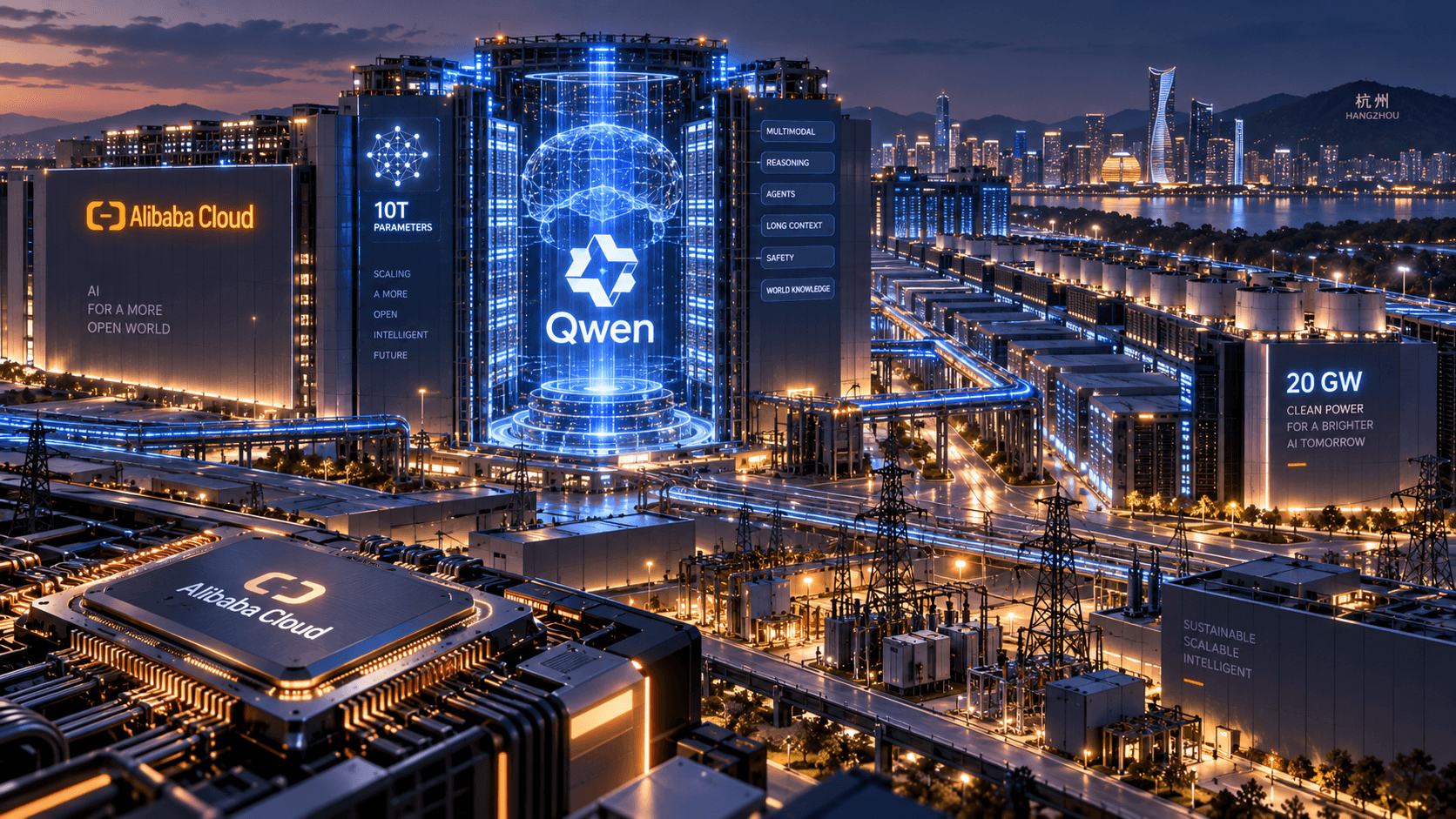
At its Apsara Conference in Hangzhou on Tuesday, Alibaba showed the Zhenwu V900 accelerator, set a 20-gigawatt capacity target for 2032 and said its next Qwen generations will be two to four times the size of the current flagship.
Key takeaways
- Alibaba plans a Qwen of 5 to 10 trillion parameters, up from 2.4 trillion in Qwen 3.8-Max.
- T-Head's Zhenwu V900 has 216 GB of memory, triples the M890 and ships in volume in early 2027.
- Alibaba Cloud aims for more than 20 gigawatts of data-centre capacity worldwide by 2032.
Alibaba plans to train a model with between 5 trillion and 10 trillion parameters, chief executive Eddie Wu said at the company's Apsara Conference in Hangzhou on Tuesday, September 22. Its chip arm, T-Head, showed the Zhenwu V900 accelerator, and Wu set a target of more than 20 gigawatts of data-centre capacity for Alibaba Cloud worldwide by 2032.
The current flagship, Qwen 3.8-Max, has 2.4 trillion parameters, so the planned model would be roughly two to four times larger, Reuters notes. Qwen 4 is in training now; the 5-to-10-trillion range belongs to Qwen 4.5 and Qwen 5, which come after it, according to TechNode Global's account of the roadmap.
The chip: what is new, and what is not disclosed
The V900 carries 216 gigabytes of memory and 1,200 gigabytes per second of inter-chip bandwidth, supports the FP8 and FP4 low-precision formats that inference now leans on, and can be linked into a single system of more than 1,000 chips. T-Head says the chip delivers three times the performance of its predecessor, the Zhenwu M890, and that with Alibaba Cloud's new network design a single cluster can scale to as many as 500,000 accelerators. Mass production and sales begin in the first quarter of 2027.
For context, the M890 is barely four months old. Alibaba launched it on May 20 with 144 gigabytes of memory and 800 gigabytes per second of inter-chip bandwidth, and it too was billed as three times faster than the chip before it, the Zhenwu 810E. T-Head said then it had shipped more than 560,000 Zhenwu chips to more than 400 external customers; on Tuesday the customer count was given as more than 650.
What T-Head did not say is as telling as what it did. There is no manufacturing partner named, no process node, no price and no absolute performance figure, only multiples of an earlier chip. Reuters frames the launch as part of a race by Chinese firms to build domestic alternatives to Nvidia's processors under US export restrictions; Alibaba itself did not put it that way on stage.
Twenty gigawatts is a different order of ambition
A year ago at the same conference, Alibaba's headline number was a three-year investment plan of 380 billion yuan in AI and cloud infrastructure. Now the target is expressed in power, not money: more than 20 gigawatts of global capacity by 2032, which puts Alibaba in the same conversation as the American hyperscalers' multi-gigawatt campus plans.
Wu told the audience that customer demand for AI was accelerating Alibaba Cloud's revenue growth, but he also conceded that global shortages across the data-centre supply chain were limiting how fast the company can expand. "The industry's mid-to-long-term demand far outpaces our supply capabilities," Reuters quotes him as saying. Alibaba Cloud will begin bringing its AI "supernodes", rack-scale systems built around its own chips, online at commercial scale this quarter.
Why the model plan matters more than the chip
Parameters are a rough gauge of size, not of usefulness, and Alibaba has not said what a 10-trillion-parameter Qwen would be for. Two clues came with it, though. Wu said the M890-based supernodes already handle inference for models above 2 trillion parameters, a capability he claimed only "a handful of companies globally" possess. And he said the Qwen team had made "meaningful progress" on recursive self-improvement, meaning models that identify their own limitations, design experiments and synthesise data. TechNode Global reports that Qwen 3.8-Max completed 33 automated improvement cycles in a month, lifting its Artificial Analysis score from 40 to 45.
That claim landed the same day OpenAI published a post saying fully autonomous self-improvement should not be pursued until it can be done safely, and asking for international standards to measure how much of it is going on inside labs. Alibaba's pitch, by contrast, was of machines that will eventually produce more than 1,000 times the "thinking" of all humanity, up from less than 3 per cent now, in Wu's framing of a "Machine Intelligence" era. The contrast is the story: one lab is asking for a ruler, another is boasting about the distance.
Two things were not addressed. Alibaba said nothing about whether the 5-to-10-trillion model would be released as open weights, though at the 2025 conference Wu called open-sourcing Qwen a way to make it "the operating system of the AI era". And nothing was said about what it will cost to train, or on whose chips.
What to watch
The V900's first-quarter 2027 production date, the Yitian 720 and 730 server processors that TechNode says are due in the third quarter of 2027, and the moment Qwen 4 leaves training. The nearer test is Thursday's Trump–Xi summit: any change to chip export rules would change the economics of everything shown in Hangzhou.
- Qwen
- Alibaba
- data centres
- Zhenwu V900
- T-Head
- AI chips
Sources
- Alibaba plans AI model with 5 trillion to 10 trillion parameters, unveils new chip — Reuters (via The Economic Times / inkl), Sep 22, 2026
- T-Head unveils Zhenwu V900 AI chip in Alibaba's push to expand its AI infrastructure stack — TechNode, Sep 22, 2026
- Alibaba targets 20GW cloud capacity by 2032 in full-stack AI push — TechNode Global, Sep 22, 2026
- Alibaba Unveils New AI Chip, Flagship Model, and Rebuilt Cloud Stack AI for Agentic Era — Alibaba Group, May 20, 2026
- Alibaba Cloud Unveils Strategic Roadmaps for the Next Generation AI Innovations — Alibaba Cloud Community, Sep 27, 2025
Related stories

Amazon blocks Meta's Muse AI agent from shopping on its store
Amazon says it first asked Meta to take its store out of Muse, without success. The dispute looks set to turn on terms of service rather than hacking law.
4 min read

Microsoft opens Hyderabad cloud region, its fourth in India, for AI
India South Central is live, with Adani Group, Bajaj Finserv, HDFC Bank and PB Pay signed up. Microsoft has not said how much AI computing capacity the region holds.
3 min read

Subscribers sue Anthropic, OpenAI, Google, SpaceXAI over AI pacing
A proposed class action filed in San Francisco says the labs' public agreement to slow frontier AI is an illegal deal among rivals. The evidence is the executives' own words.
4 min read
Comments
No comments yet. Start the conversation.