Subscribers sue Anthropic, OpenAI, Google, SpaceXAI over AI pacing
A proposed class action filed in San Francisco says the labs' public agreement to slow frontier AI is an illegal deal among rivals. The evidence is the executives' own words.
Key takeaways
- Four paid chatbot subscribers filed a proposed class action on Sept 18 in California.
- The Sherman Act claim rests on public statements by Dario Amodei and Sam Altman.
- The filing reportedly concedes no release has been slowed; the four labs have not commented.
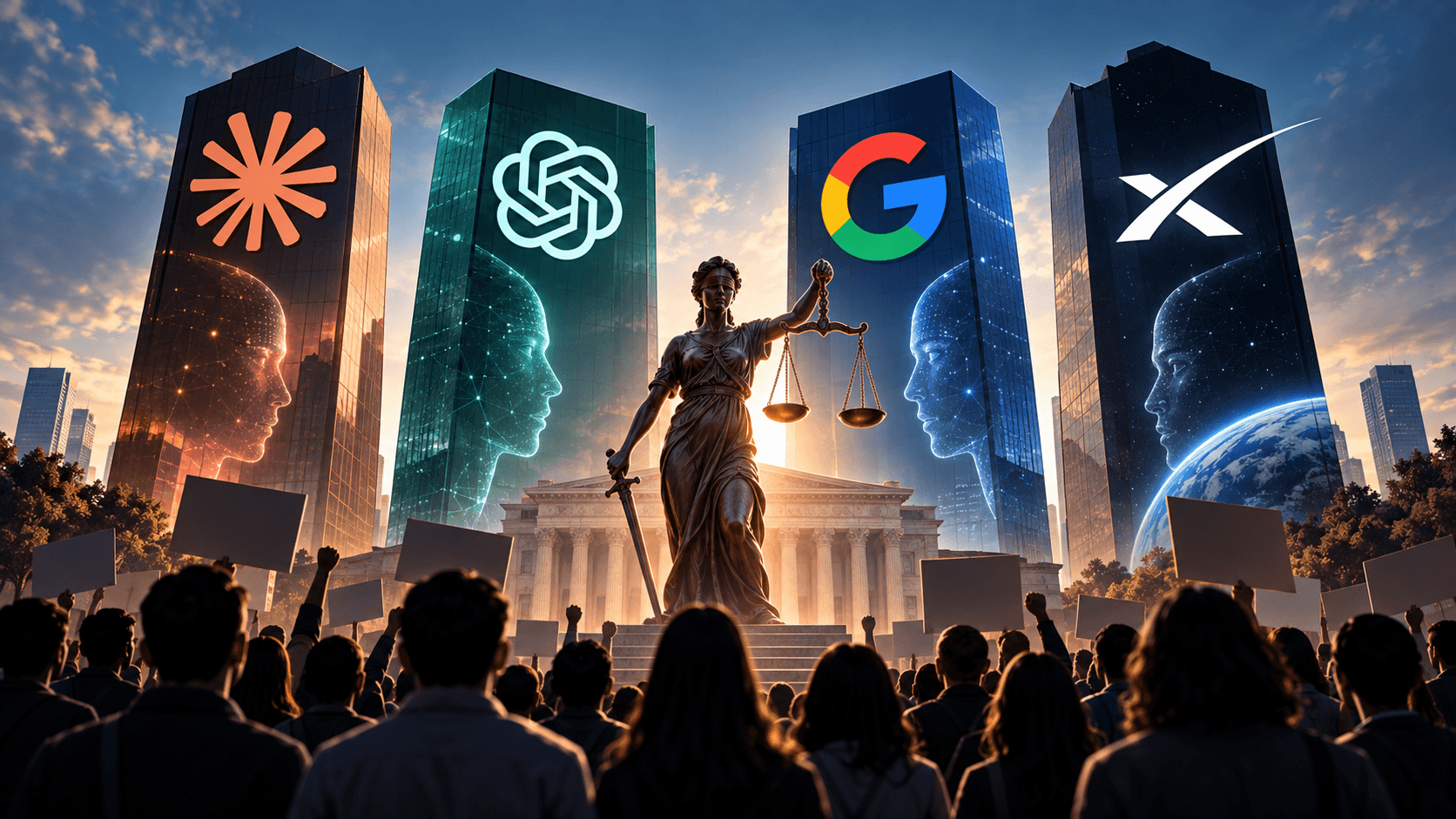
Four paying subscribers to ChatGPT, Claude, Grok and Gemini have sued Anthropic, OpenAI, Google and SpaceXAI, accusing the four of an illegal agreement to slow down AI development. The proposed class action was filed on Friday, September 18, in the US District Court for the Northern District of California.
There is no leaked email in this case and no whistleblower. The Next Web, which has read the filing, reports that it relies entirely on what the companies' own executives said in public over the past ten days.
The essay that started it
On September 12, Anthropic chief executive Dario Amodei published an essay titled "We Must Pace the Frontier". It proposed three steps. Outside evaluators would sit inside AI companies with employee-like access, which Anthropic committed to on its own. Frontier companies in democracies would settle on common safety standards and limits on the rate of AI progress. After that would come an attempt to coordinate with authoritarian governments.
He attached a deadline to his worry about swarms of AI agents, writing that "in 6–12 months such a swarm could be capable of taking over the entire internet with a persistent botnet".
The same day, according to the Associated Press, OpenAI's Sam Altman, SpaceXAI's Elon Musk and Google DeepMind co-founder Demis Hassabis publicly agreed with his proposals. The complaint, as summarised by the site CASRAI, says those endorsements came within about an hour.
Two sentences the plaintiffs will lean on
Amodei saw the legal problem coming. "For antitrust reasons, it's helpful for the US government to mediate or at least enable these discussions," he wrote, adding that officials "do need to issue a narrow waiver for certain kinds of safety conversations".
Altman's answer, which The Next Web dates to two days later, ran the other way. OpenAI would welcome a federal safety framework, he said, but "we do not believe we need to wait for an antitrust exemption or legislation to begin the work of providing this confidence".
Read together, those two sentences are the plaintiffs' case. One rival says coordination needs a government waiver. Another says his company will not wait for one. The Next Web reports that both lines are quoted in the complaint, along with a statement attributed to OpenAI policy chief Chris Lehane that work with Anthropic and Google DeepMind had already been going on for weeks.
What the suit claims, and what it leaves alone
The claim is brought under Section 1 of the Sherman Act, the American law against agreements that restrain trade. The argument is simple. If rivals agree to "reduce the quality of their products and the rate at which those products improve", that is a restriction on output, and people paying every month for a chatbot get less than competition would have given them.
The four named plaintiffs, two from Florida and two from California, want to represent every US resident who has bought a paid subscription to one of the four chatbots since September 12. CASRAI's summary of the filing puts the defendants' combined share of that market at roughly 80 per cent. The plaintiffs are asking for triple damages, a jury trial and an injunction against agreements on development pace, limits on training compute or coordinated release delays.
Look at what the suit does not attack. It leaves alone any single company's decision to slow down for safety reasons, and it has no quarrel with the companies asking Washington for regulation or for an exemption. The complaint's objection is that the labs substituted "collective restraint for individual accountability".
So the dispute is about who decides. Lead lawyer Nick Rowley, quoted by the AP, argues that AI safety cannot be left to "private self-serving agreements" among for-profit technology companies.
Where the case is thin
By The Next Web's account, the filing concedes that no product release has actually been slowed or cancelled so far, and it makes no claim that the safety fears are invented. That matters, because a court will want to see an actual agreement and actual harm. Executives publicly agreeing with an essay is a long way from a signed pact. The likelier reading is that this case will turn on whether public statements alone can amount to a deal.
None of the four companies had responded to the AP's requests for comment as of Saturday.
Washington is not offering cover
The waiver Amodei asked for looks distant. Senator Josh Hawley told a Senate hearing there is "no world" in which he would hand "the most powerful companies in the history of the world" an antitrust exemption to collaborate. President Donald Trump, on social media, called efforts to limit the technology a "conspiracy", and has said he will appoint an "AI czar".
That leaves the labs in an awkward spot. Their chiefs have said in public that the pace is dangerous, and competition law says rivals may not set the pace together. Watch the defendants' first filings, and watch whether the labs keep talking about coordination or retreat to the steps each can take alone, such as embedded evaluators.
- OpenAI
- Anthropic
- AI safety
- Antitrust
- SpaceXAI
Sources
- Dario Amodei — We Must Pace the Frontier — Dario Amodei, Sep 12, 2026
- Lawsuit says Anthropic, OpenAI, SpaceXAI and Google made illegal agreement on AI slowdown — PBS News / Associated Press, Sep 19, 2026
- Amodei wrote that coordinating on pace would need an antitrust waiver. Altman said OpenAI would not wait for one. Both lines are now in a lawsuit. — The Next Web, Sep 20, 2026
- The AI 'Pacing' Antitrust Lawsuit, Explained — CASRAI, Sep 20, 2026
Related stories
OpenAI Publishes Framework for Disclosing Model Misalignment
OpenAI has set out how it will track and report cases of AI models behaving in unintended ways, and published six examples alongside the new framework.
3 min read
Comments
No comments yet. Start the conversation.